
INDOOR AIR QUALITY / CO₂
Indoor CO₂ Build-up: Cool Air Can Still Be Under-Ventilated
An occupied, closed room can accumulate carbon dioxide even when it feels cool and particle levels are low. Good indoor air design must account for people, pollutant sources and the outdoor air actually delivered.
Published 5 October 2026

Cooling does not prove air exchange
A meeting room or bedroom can feel comfortable while occupants continuously exhale CO₂. Without sufficient outdoor air exchange, its concentration rises. CO₂ itself has no smell that reliably warns occupants.
Concentrations are usually expressed in parts per million: 1,000 ppm is 0.1% by volume. This measures room air, not blood CO₂ or every aspect of indoor air quality.
Room accumulation and clinical hypercapnia
Here, CO₂ build-up means accumulation in room air. Clinical hypercapnia means elevated blood CO₂, for example when the lungs cannot remove enough gas. A room monitor cannot diagnose it. NHS patient information
Occupancy changes the ventilation load
People are an important source in ordinary occupied rooms. Emissions depend on activity and occupant characteristics. A crowded, active room has a different load from a lightly occupied resting space.
A larger room slows the rise; it does not lower the eventual steady concentration if generation and outdoor airflow stay unchanged. NIST QICO₂ evaluates both time-dependent and steady concentrations.
One room, three outdoor airflow rates
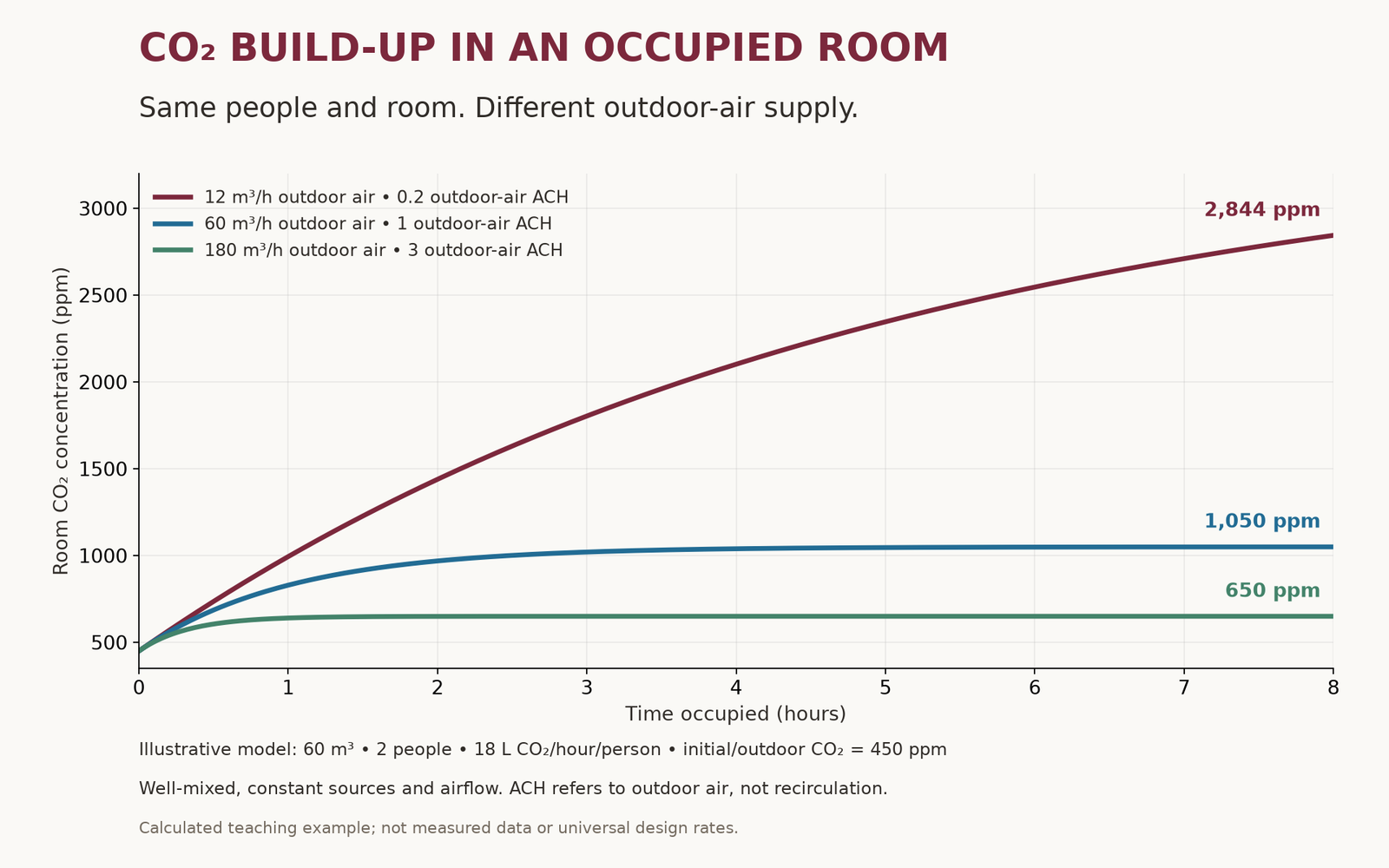
Our teaching example assumes a 60 m³ room, two occupants emitting 18 litres of CO₂ per hour each, and outdoor and initial CO₂ of 450 ppm. These are illustrative assumptions, not measurements or universal emission rates.
Outdoor airflows of 12, 60 and 180 m³/h produce calculated steady concentrations of 3,450, 1,050 and 650 ppm. Early readings can look modest even when sustained occupancy will produce a substantial increase.
Symptoms require careful interpretation
Headache, sleepiness, fatigue and reduced concentration reported in stuffy rooms can involve heat, odours and other pollutants. Evidence for direct effects of CO₂ at commonly encountered indoor concentrations remains inconsistent; 1,000 ppm is not a universal symptom threshold. ASHRAE Position Document 2025
At very high concentrations, CO₂ can directly cause dizziness, breathing difficulty, confusion or unconsciousness; concentration and exposure duration matter. NIOSH Pocket Guide Seek safe air and medical help for breathing difficulty or confusion rather than waiting for a displayed limit.
CO₂ cylinders, dry ice and substantial process emissions require a separate hazard assessment; ordinary meeting-room monitoring is not a substitute.
International values serve different purposes
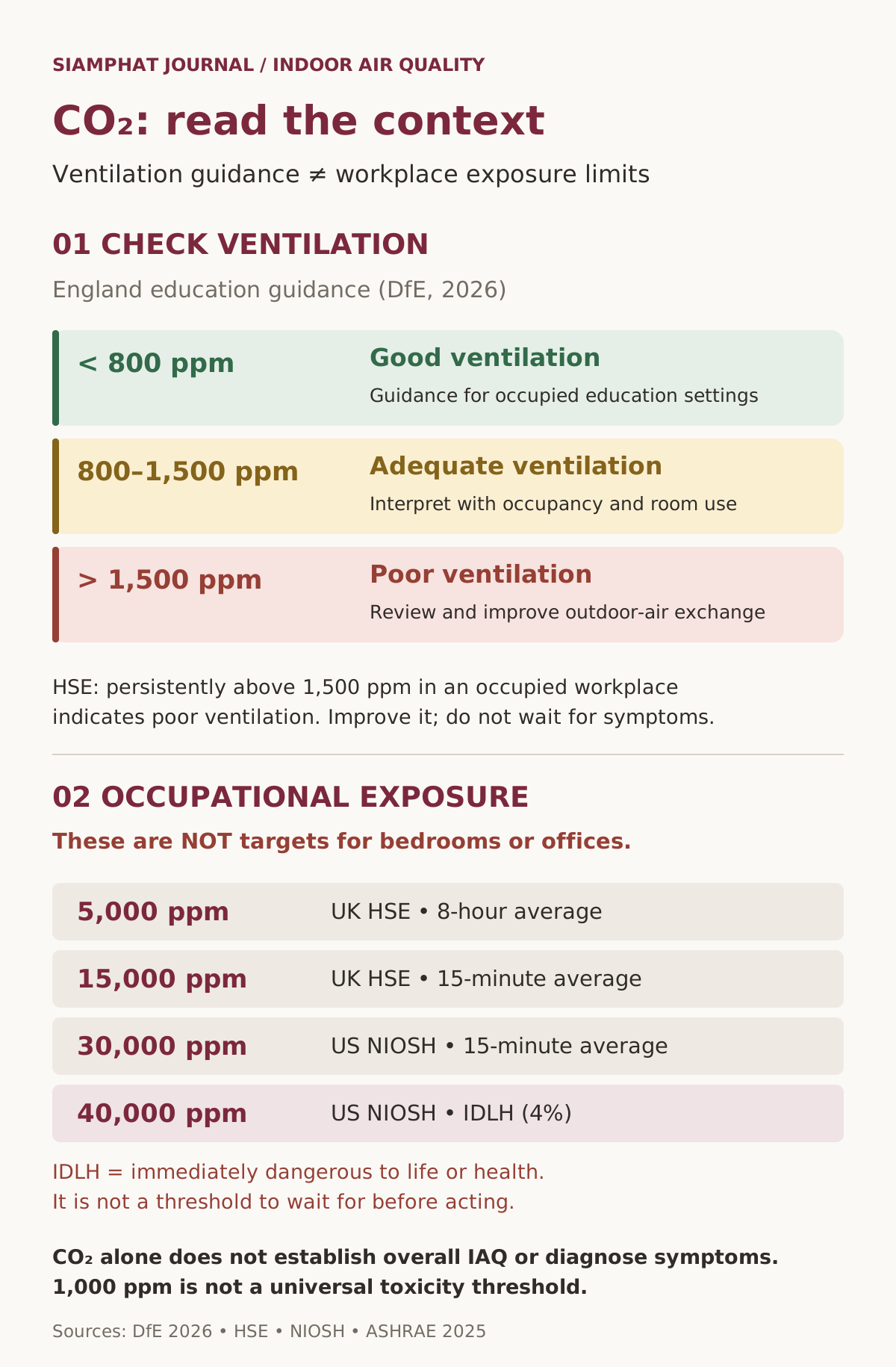
Ventilation guidance and occupational exposure limits answer different questions. The table gives the context and reference period: occupational limits are not bedroom or office design targets.
1,000 ppm is not a universal toxicity limit or an ASHRAE pass value for every room. DCV settings depend on the space and design method. ASHRAE clarification
These international references are not a declaration of Thai legal requirements. Check the requirements applicable to the actual project.
Reference table and source links
| CO₂ value | Meaning and context | Reference |
|---|---|---|
| Persistently above 1,500 ppm | HSE occupied-workplace guidance: poor ventilation; improve it. Not a toxicity threshold. | HSE monitoring |
| Below 800 / 800–1,500 / above 1,500 ppm | England education guidance: good / adequate / poor ventilation in that setting. | DfE education guidance |
| 5,000 ppm, 8-hour average | UK HSE long-term workplace exposure limit, not a residential design target. | HSE workplace limits |
| 15,000 ppm, 15-minute average | UK HSE short-term workplace exposure limit. | HSE |
| 30,000 ppm, 15-minute average | US NIOSH recommended ST exposure limit; different from the UK value. | NIOSH |
| 40,000 ppm (4%) | NIOSH immediately dangerous to life or health (IDLH); not a value to wait for before acting. | NIOSH IDLH |
ASHRAE guides the ventilation system
ANSI/ASHRAE 62.1-2025 addresses ventilation in many building occupancies; 62.2-2025 addresses nontransient residential dwelling units, including whole-unit ventilation, local exhaust and source control. Standards 62.1 and 62.2
Start with space use, occupancy, area and air distribution, then check outdoor air actually delivered. CO₂ assists verification; it does not replace the applicable design calculation or airflow measurement.
A useful engineering estimate
For a well-mixed room at steady state, Cᵢ = Cₒ + 10⁶G/Q, with concentrations in ppm and both CO₂ generation G and outdoor airflow Q in m³/h. Choosing an illustrative indoor value of 1,000 ppm and outdoors at 450 ppm gives Q = 0.036 × 10⁶ / 550 ≈ 65.5 m³/h, or 9.1 L/s per person for two occupants.
That chosen 1,000 ppm value is an example, not a universal recommendation. Activity, outdoor concentration, short-circuiting and inter-zone flows change the result. Applying a steady-state equation before equilibrium can misestimate ventilation.
Time-dependent equation and model limitations
C(t) = Cₒ + 10⁶G/Q + [C(0) − Cₒ − 10⁶G/Q]e−Qt/V.
V = 60 m³; G = 0.036 m³/h; Cₒ = C(0) = 450 ppm; t: h; Q: m³/h.
Assumes uniform mixing, equal inlet/outlet volume flow, constant generation and outdoor air, no inter-zone transfer or CO₂ sorbent, and gas volumes on the same reference basis. It does not replace a standards-based ventilation design.
Cooling, filtration and ventilation are different jobs
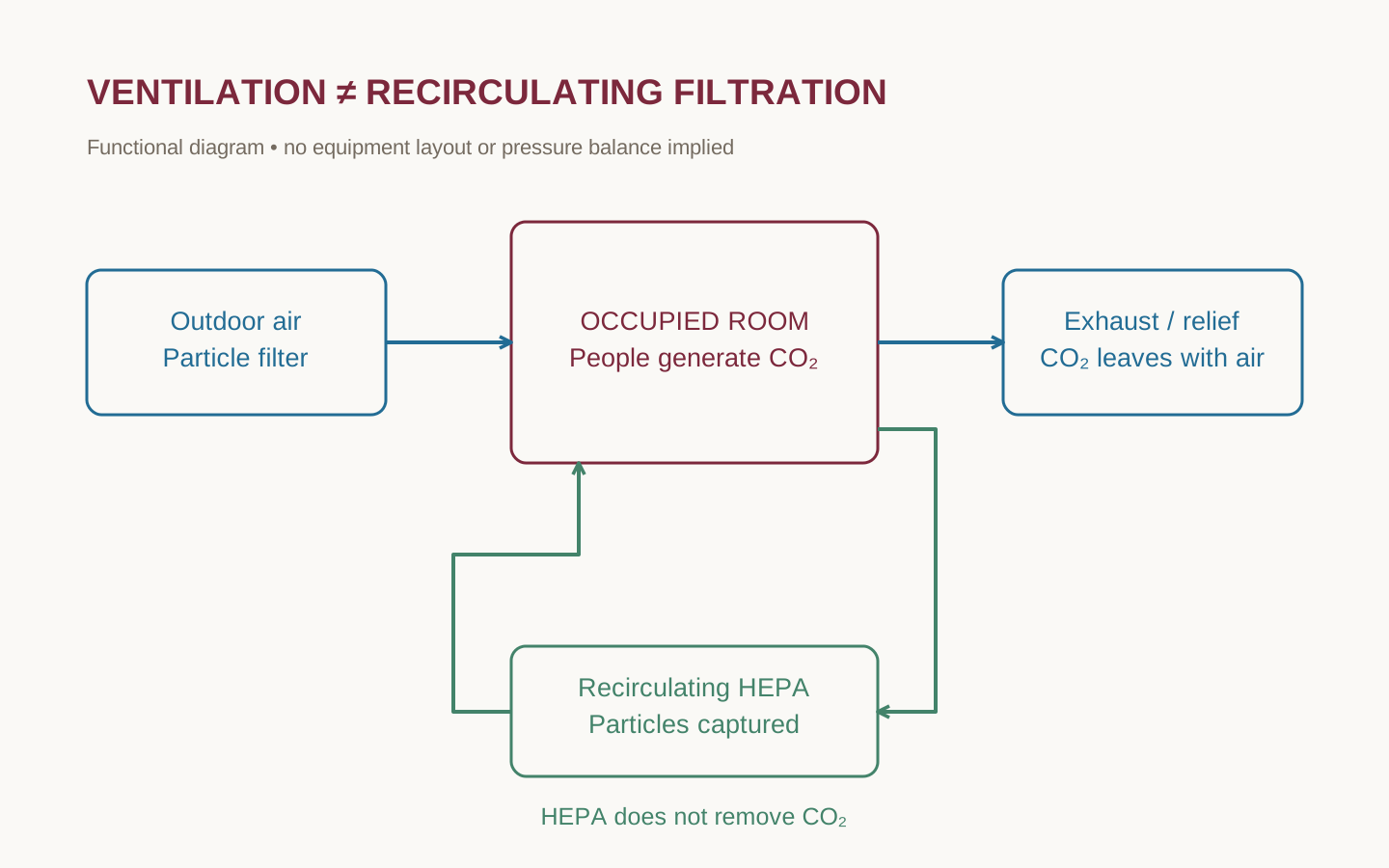
Recirculating air conditioning cools indoor air without necessarily supplying outdoor air. HEPA captures particles, not CO₂. England’s Department for Education explicitly distinguishes air cleaning from ventilation and CO₂ reduction.
Provide an appropriate outdoor-air supply and an outlet. When outdoor PM2.5 is elevated, consider filtered supply and a clean intake location rather than indiscriminate window opening. US EPA IAQ guidance
For dust-protection positive-pressure rooms, sealing needs filtered supply and a designed relief path. Check CO₂, airflow and pressure together. Positive pressure alone does not prove adequate outdoor ventilation. Select the fan at its actual operating point with ducts and filters.
Measure representative conditions
Use an NDIR CO₂ monitor with specified accuracy and calibration procedures. Place it around head height in the occupied area, at least 0.5 m from people and away from windows, doors and supply outlets. Log readings across occupied periods with occupancy and system status. HSE monitoring guidance
Look at overnight bedroom trends and fully occupied meetings. Follow manufacturer calibration instructions, assess multiple zones where necessary and measure representative outdoor intake conditions.
Ventilate adequately without unnecessary energy use
Demand-controlled ventilation can adjust outdoor air to actual use, combining CO₂ with occupancy, schedules and minimum ventilation requirements. Allow for sensor response and concentration lag rather than always starting ventilation only after a high reading.
Retain ventilation for sources unrelated to occupancy. HRV/ERV may reduce conditioning loads, depending on equipment and operating conditions; humidity, cross-stream leakage, filtration and maintenance still require design attention in hot, humid climates.
Design indoor air quality as a whole
CO₂ is an important factor for assessing occupancy-related outdoor air needs. Also address PM2.5, volatile compounds, combustion sources, humidity and temperature: low CO₂ does not prove low particle or chemical exposure.
Survey occupancy and sources, log occupied trends, measure delivered supply and exhaust, adjust and verify again after occupancy or filter changes. The objective is sustained suitable air for people.
Every space has its own requirements. Let’s start by understanding yours.
Discuss your project