
06 / Outdoor & semi-open cooling
Outdoor & semi-open spot cooling
Improve the occupied area—not an imaginary sealed outdoor room.
Open and semi-open spaces do not retain cooled air like enclosed rooms. Wind, solar and surface radiation, and humidity shape what people experience. Equipment selection should start with occupied locations and operating times.
A practical approach can combine shade, radiant-heat control, airflow and spot cooling. Define the useful zone rather than promise one temperature across the whole site.
Content reviewed 6 October 2026
Discuss the application →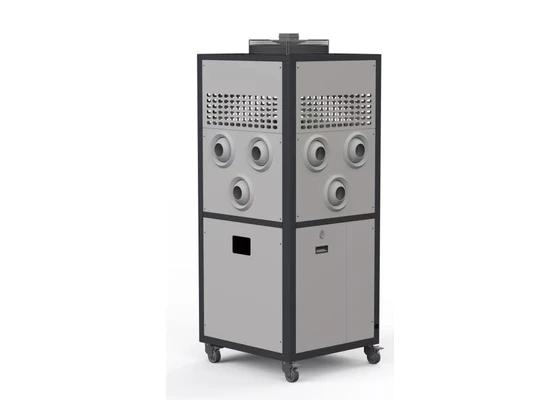
People receive heat from more than the air
Under a hot roof or next to a sunlit surface, radiant exposure can matter even when air temperature is not at its maximum. Cooler discharge air alone may leave the dominant exposure unresolved.
Comfort assessment includes temperature, radiation, humidity, air speed, activity and clothing.[1] Occupational heat hazards need a workplace assessment and coordinated measures, not a discharge-temperature reading as a safety test.[2]
Place the cool-air route and the hot-side route
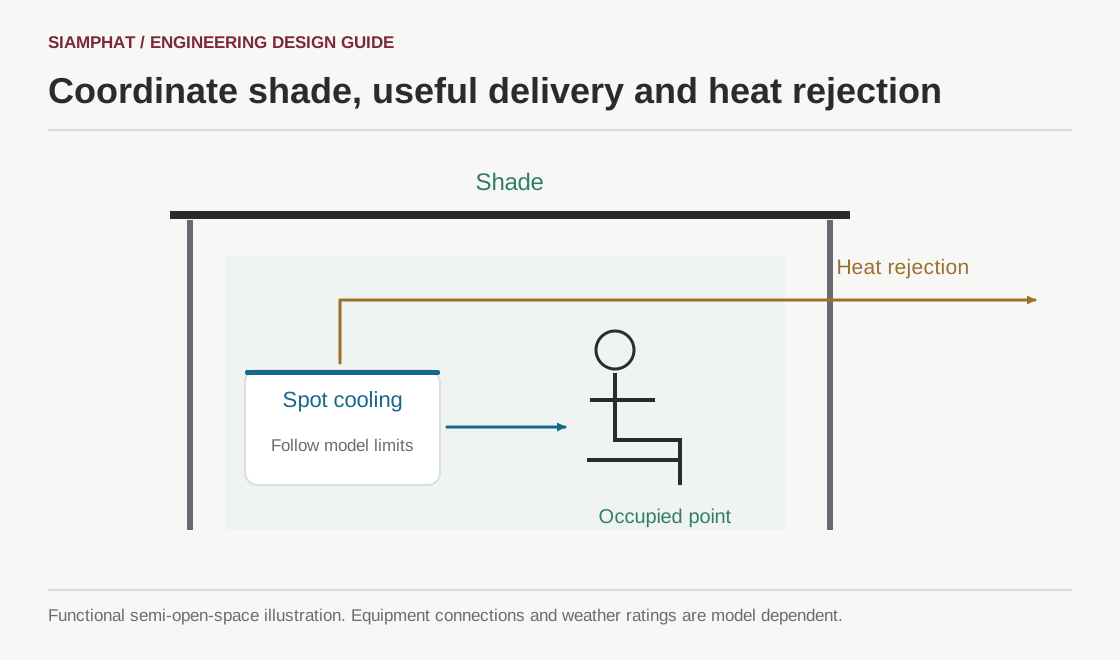
Spot cooling needs useful delivery to the occupied position while keeping rejected heat away from it. Crosswind and obstructions can move the cool plume off target.
Some portable equipment uses a hot-air exhaust duct; other equipment has a separate outdoor unit. Follow the actual model limits for ducts and exposure. Relocatability does not establish unlimited duct length or rain resistance.
Compare environmental measures and equipment
| Approach | Intended benefit | Limitation |
|---|---|---|
| Shade/radiant control | Reduce direct solar and surface exposure | Air and airflow still need assessment |
| Fans/airflow arrangement | Increase local air movement | Not refrigerant-cycle cooling; benefit depends on conditions |
| Refrigerated spot cooling | Deliver conditioned air to the target | Crosswind, rejected heat, drainage and energy |
| Direct evaporation | Reduce dry-bulb temperature where conditions allow | Adds moisture; needs appropriate air exit and water care |
Direct evaporation differs from refrigerant-cycle cooling. Equipment using water on the rejection side does not automatically add moisture to its supply air; identify where the process occurs.[3]
Survey when the problem occurs
- Occupied positions and times, sun direction, shade and hot surfaces.
- Relevant wind, obstacles and useful discharge reach.
- Outdoor temperature/humidity, activities and the intended result.
- Electrical supply, drainage, hot-side location, noise and service access.
- Actual weather/dust ratings and electrical installation requirements.
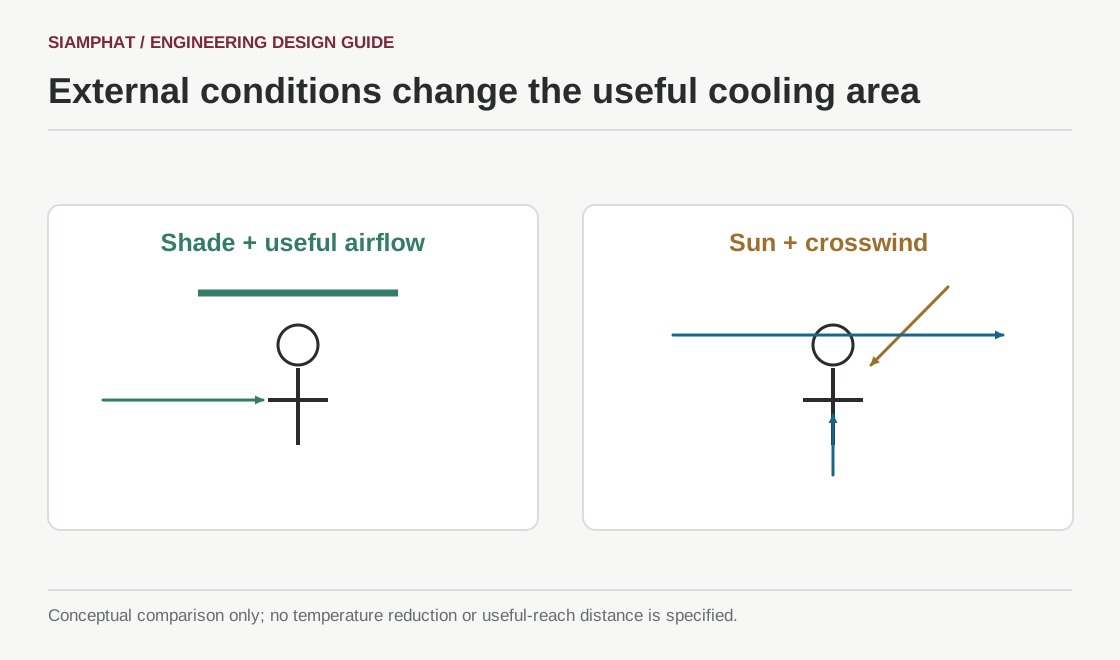
The useful cooling zone changes with conditions
Define the target so the team can assess whether the discharge reaches people or is carried away. If wind varies, terminal arrangement or relocatable equipment may need evaluation.
Humidity affects evaporation and comfort. Dry-weather demonstrations do not establish humid-day performance. Combining appropriate shade with cooling often provides a clearer objective than adding capacity while occupants remain exposed to sun.
Application: a semi-open waiting area
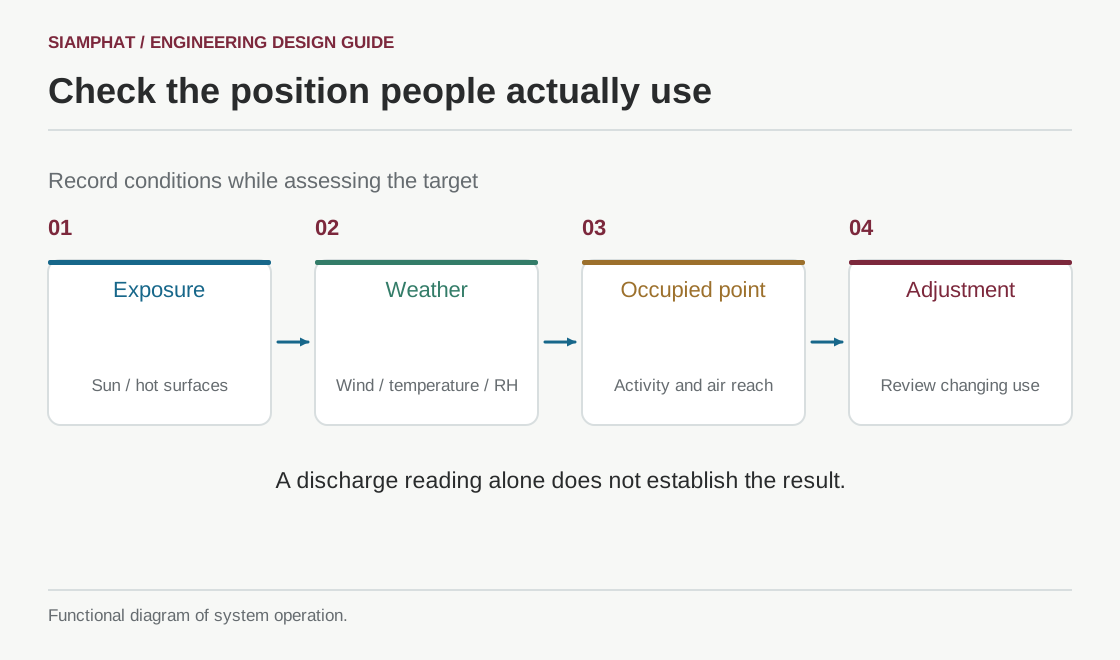
Measure at the occupied positions
- Record sun, wind, humidity, activity and time.
- Assess target positions and crosswind effects.
- Check hot-side placement, drainage, electrical work and mounting.
- Agree operating limits and adjustment when weather or layout changes.
Maintain filters, coils, fans and drainage as applicable. Water-based systems also need their own water-management and cleaning instructions; maintenance duties are not interchangeable across technologies.
Siamphat starts with the target area
We assess spot cooling together with environmental conditions, airflow, electrical interfaces and care. Define measurable objectives and constraints before equipment selection.
Photographs, a plan, occupied locations, problematic hours and installation constraints help separate environmental measures from mechanical-cooling needs.
Questions about open-space cooling
Can a whole open yard feel like an air-conditioned room?
That is not a reasonable assumption for spot equipment. Define the useful zone and external conditions.
How far will the cold air reach?
It depends on the model, terminal, flow, obstacles and natural wind. Use equipment information and site checks.
Is direct evaporation suitable in humid air?
Assess dry-/wet-bulb conditions and the added moisture. Its limits differ from refrigerant cooling.
Can portable equipment be placed anywhere?
It still needs suitable electrical supply, drainage, rejection, exposure and safe circulation around the installation.
References and scope
- ASHRAE — Standard 55: Thermal Environmental Conditions for Human Occupancy (2023) ↗
- NIOSH — Workplace Recommendations: Heat Stress ↗
- U.S. DOE — Best Management Practice #13: Other Water-Intensive Processes ↗
Sources support principles; they are not product certificates or a claim of project compliance. Actual design requires the applicable editions, requirements, model data and installation conditions. Residential or general sensor guidance does not substitute for special-purpose building criteria.
Connect the complete system
DISCUSS YOUR PROJECT
Where should you start with a hot open space?
Tell us where people stay, when heat is a problem and the site constraints so we can discuss targeted cooling and environmental design.
Start with a plan, site photographs, existing equipment and the times when the problem occurs.