
PERSPECTIVE / SYSTEM THINKING
Better air begins with the whole system
A capable air cleaner, a powerful fan or comfortable cooling may still leave a problem unresolved. Good air depends on how occupants, sources, airflow and equipment interact.
Revised 5 October 2026
Imagine a meeting room with effective cooling and a good particle air cleaner. Particle readings improve, but the room still feels stuffy when fully occupied. Should the owner buy another purifier?
If outdoor-air ventilation is the main problem, adding particle filtration will not resolve occupant-generated CO₂ accumulation.
This hypothetical example illustrates how individual devices can perform their own functions well while the room as a whole still falls short.

Define the problem before choosing equipment
Dust entering from a road, indoor chemical emissions, stuffiness during busy meetings and persistent dampness require different responses. Establish sources, activities, occupancy, operating hours and building constraints first.
EPA combines source control and ventilation with clean outdoor air, supplemented by filtration. No air cleaner removes every pollutant. EPA guidance
For an introduction, read What is IAQ?
Filtration and ventilation cannot simply replace each other
Particle air cleaners recirculate room air through filters. Ventilation provides air entry and exit. HEPA filters do not remove CO₂; appropriate outdoor-air provision and exit routes remain necessary. Conversely, admitting polluted outdoor air without suitable treatment can increase particle exposure.
High recirculating airflow is not the same as high outdoor airflow. Read more about indoor CO₂ accumulation.
Catalogue airflow is not necessarily installed airflow
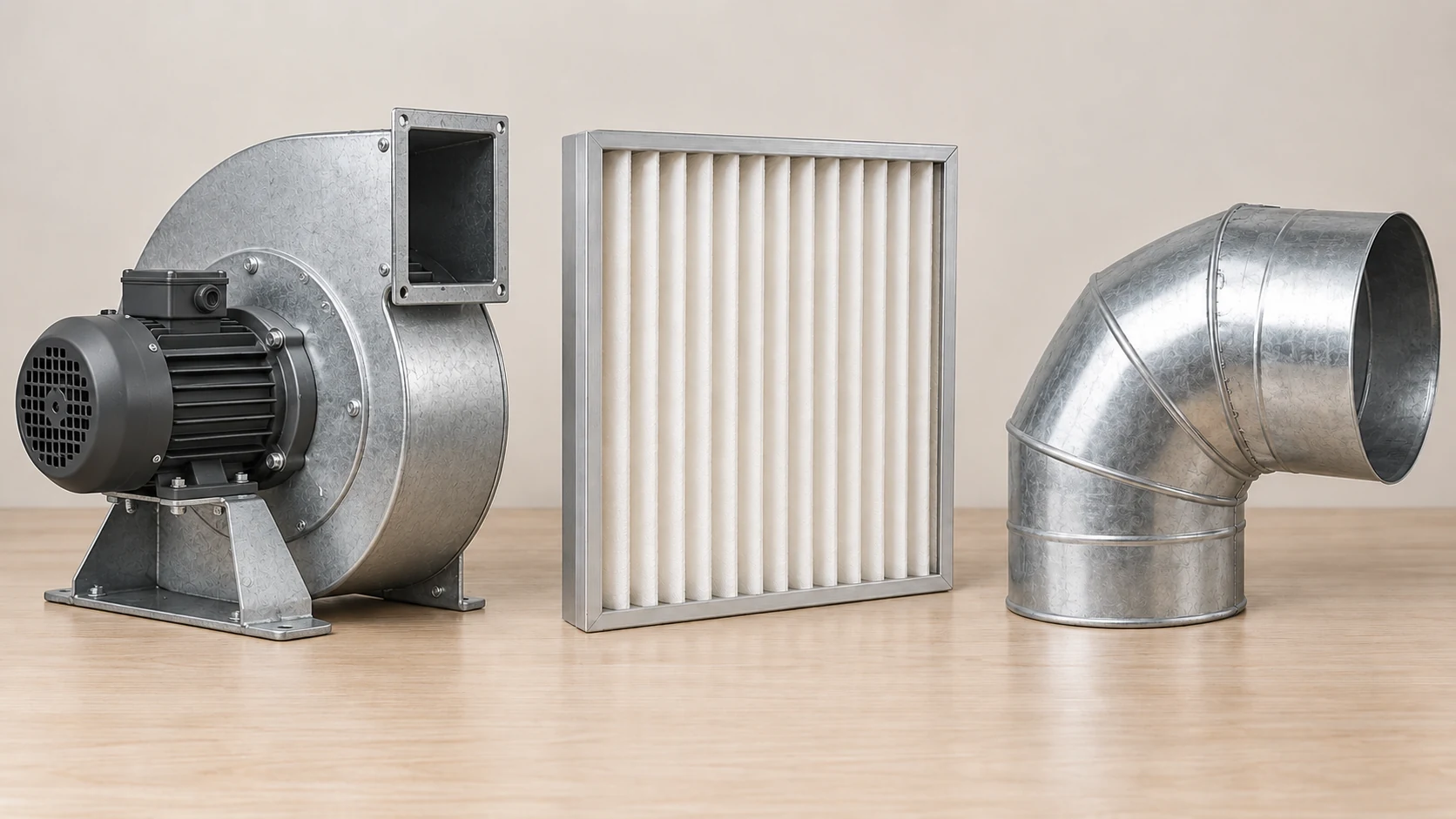
Read airflow together with pressure and test conditions. Maximum airflow at low resistance should not be assumed to remain available through grilles, filters, ducts and bends.
The operating point is where the fan performance curve meets the system curve. Compare pressure on a consistent basis; static and total pressure curves cannot be mixed without considering their definitions and test conditions. AMCA: reading fan curves
As filters load, resistance can increase. Airflow commonly changes in fixed-speed systems. Constant-airflow controls may increase speed and power within equipment limits. The outcome depends on the fan and control strategy. Read more about centrifugal and axial fans.
Does supply air reach the occupied area?
Meeting a total airflow target does not establish appropriate distribution. Supply air may leave near an outlet before adequately serving occupied areas. Partitions, furniture and changes in room layout can alter air distribution.
Bends close to fan connections and nonuniform inlet or outlet flow can also change installed performance relative to laboratory conditions. This is known as system effect. AMCA: system effect
Positive pressure needs supply and exit paths
For outdoor dust control, coordinate sealing, filtered supply and an appropriate pressure difference relative to adjoining areas. A room also needs suitable air exit paths.
Bathroom and kitchen exhaust systems can change the balance if replacement air is insufficient. Opening doors also changes pressure and airflow. Positive pressure helps control air movement; it does not remove indoor chemical emissions, odours or moisture. Spaces intended to contain contaminants may need a different pressure strategy.
Outdoor air brings thermal and moisture loads
In hot, humid conditions, outdoor air adds both heat and moisture. Increasing ventilation without checking conditioning capacity can make room conditions harder to control.
Consider sensible and latent loads. Energy recovery may reduce part of the load depending on equipment and operating conditions, but does not replace appropriate filtration, moisture control or maintenance.
Persistent leaks and condensation need direct correction. WHO associates dampness and mould in buildings with respiratory health problems. WHO guidance
Energy efficiency should maintain appropriate air provision and IAQ requirements, rather than reduce airflow until pollutants accumulate.
Use sensors to answer specific questions
PM₂.₅, CO₂, temperature and humidity provide different information. An anemometer measures air velocity, not pollutant concentrations. Low CO₂ does not establish the absence of dust or chemical emissions.
CO₂ interpretation depends on measurement accuracy, placement, calibration and other limitations. ASHRAE position document
Readings near a person’s exhaled breath may not represent the room. Empty-room readings may not represent a full meeting. Record occupancy, activities, time and system status alongside trends. Sensor-based controls still require appropriate minimum airflow and operating rules.
The job is not complete when equipment starts
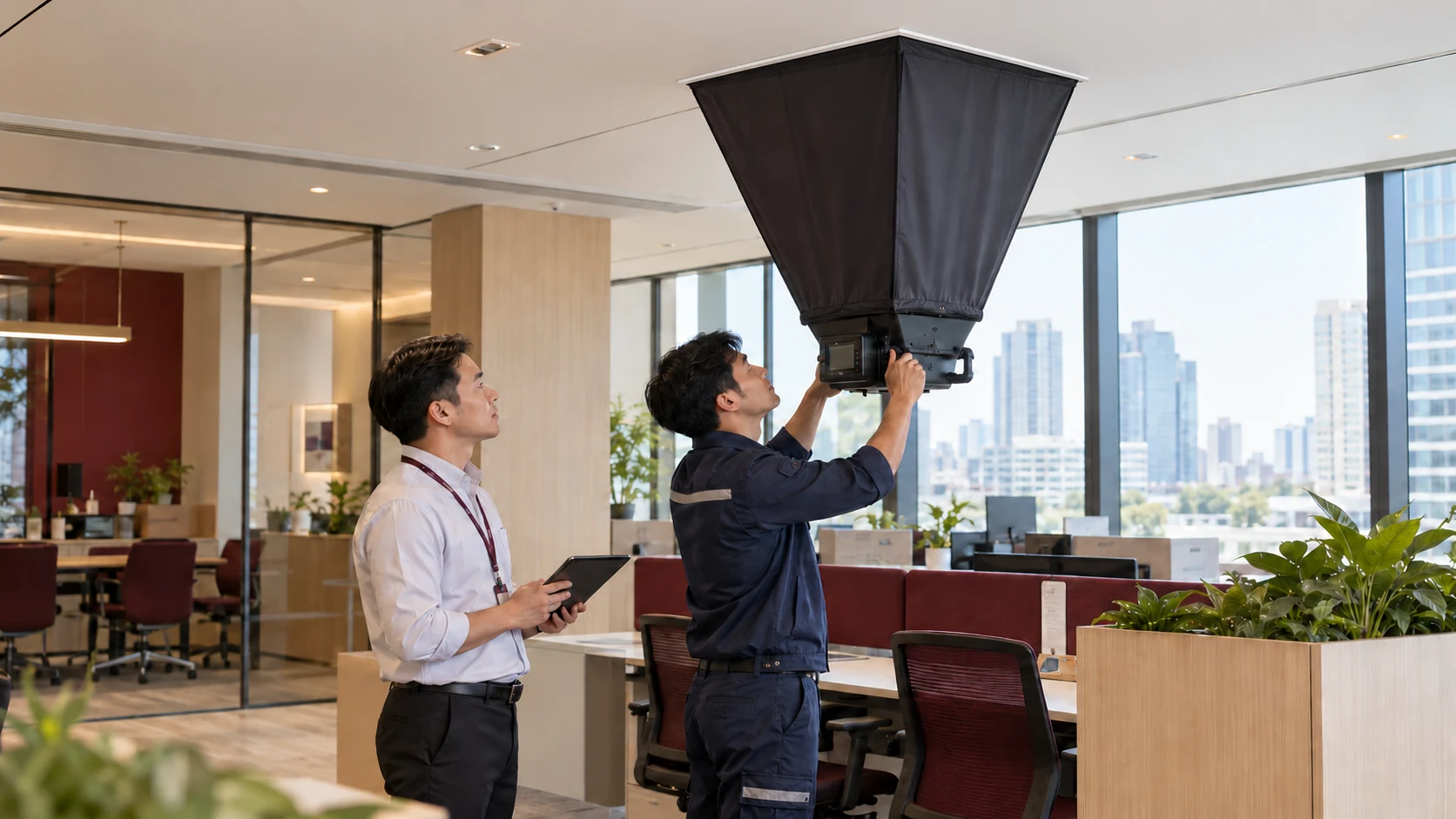
Verify performance against agreed objectives under representative operating conditions.
- Airflow: measure actual supply and extract, including concurrent equipment operation.
- Pressure and distribution: check intended flow direction and service to occupied areas.
- Relevant room variables: assess trends during actual occupancy and activities.
- Maintainability: ensure access to filters, drains and equipment.
- Handover: explain operation, warnings and follow-up checks.
Record a baseline for comparison as filters load or room use changes. ASHRAE’s IAQ Guide addresses design, construction, commissioning and maintainability. ASHRAE IAQ Guide
The Siamphat approach: focus on the space’s outcome
Understand the problem, investigate sources and constraints, define verifiable objectives, select and integrate suitable systems, then check operation and plan ongoing maintenance.
Equipment decisions should reflect the room’s requirements as well as budget, noise, energy and maintenance.
Ask how the system will address your particular problem—and how its performance will be verified. If a room remains stuffy despite cooling, or dusty despite installed equipment, review airflow and use before adding another device.
Every space has its own requirements. Let’s start by understanding yours.
Discuss your project