
03 / Filtration & air treatment
Filtration & air treatment
Match the filter to the pollutant—and to the air system.
Air filtration can protect equipment, reduce particles in occupied spaces or form part of a treatment train for specific gases. Those are different duties. A HEPA label or a long list of filter stages does not, by itself, establish a suitable solution.
Selection needs the target pollutant, actual airflow, housing integrity and a maintainable replacement plan. The installed system matters as much as the media.
Content reviewed 6 October 2026
Discuss the application →
Identify particles, gases and the source
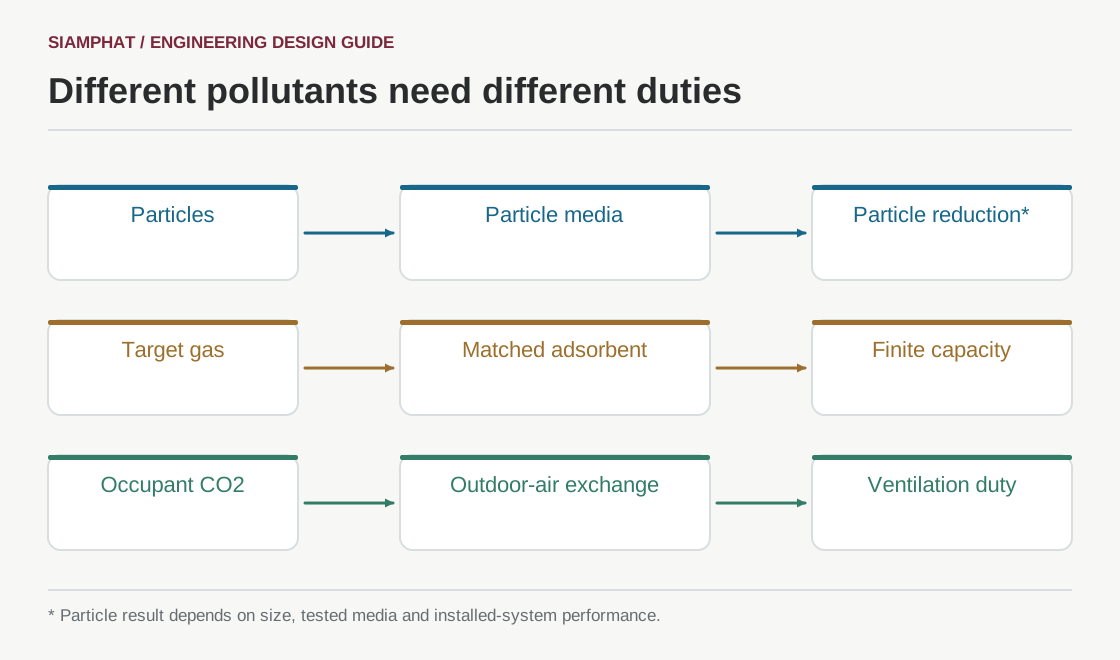
PM2.5 is particulate matter; many odours and volatile substances are gases. Particle media and gas-treatment media serve different duties. Odours may also originate in drainage, moisture or a source that should be corrected directly.
Assess where and when the problem appears, airflow paths and indoor/outdoor sources before adding stages. Filtration should not replace feasible source control.[3]
Understand the mechanism and the limits
Fibrous filters capture particles through several mechanisms, not simply sieve openings smaller than the particle. Performance depends on particle size, media and test conditions. An efficiency claim needs a stated test basis.[1]
Gas adsorbents require selection for the substance, concentration and operating conditions. Capacity is finite. Particle performance cannot substantiate gas removal, and ordinary particle filters, including HEPA, do not remove occupant-generated CO₂.
Compare treatment duties rather than stage counts
| Approach | Application | Check |
|---|---|---|
| Prefiltration | Share loading and protect downstream sections | Classification, area and resistance |
| Fine/HEPA where required | Particles in supply or recirculated air | Test data, pressure drop and sealing |
| Gas/odour media | A supported target substance | Capacity, contact time, humidity and replacement |
| Room recirculating cleaner | Supplemental treatment in a defined area | Clean-air delivery, location and usable sound level |
MERV reports particle-filter performance within its test framework. It is not a direct conversion to HEPA or another classification. Compare results using the definitions of the relevant test method.[2]
Resistance and bypass belong in the specification
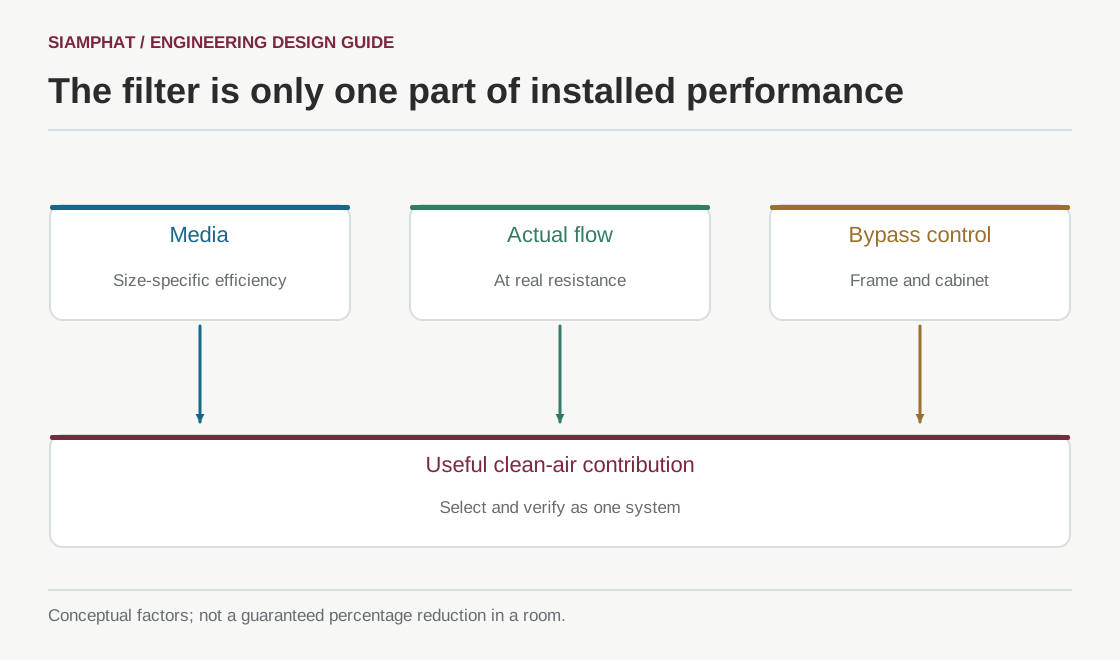
An upgrade can change the flow of an existing fan. Resistance changes again as dust loads the filter. Check the fan curve and filter duty together; filters with similar classifications do not necessarily have identical pressure drops.
- Flow, face velocity and pressure drop for the selected model.
- Clean condition and manufacturer-defined loaded/replacement limits.
- Frame, cabinet and access-door sealing to prevent bypass.
- Removal access, used-filter handling and monitoring provisions.
Media efficiency is not room improvement
Room particle levels depend on treated flow, size-specific efficiency, mixing, sources and outdoor entry. Short-circuiting air around a cleaner can reduce its useful contribution.
For room cleaners, evaluate clean-air delivery against the space and use. For duct filters, verify flow after upgrades. Do not turn a media efficiency into a guaranteed percentage reduction across a room.
Application: adding filtration to an existing air system
Define inspection and replacement from evidence
- Check the filter model, orientation and sealing against the schedule.
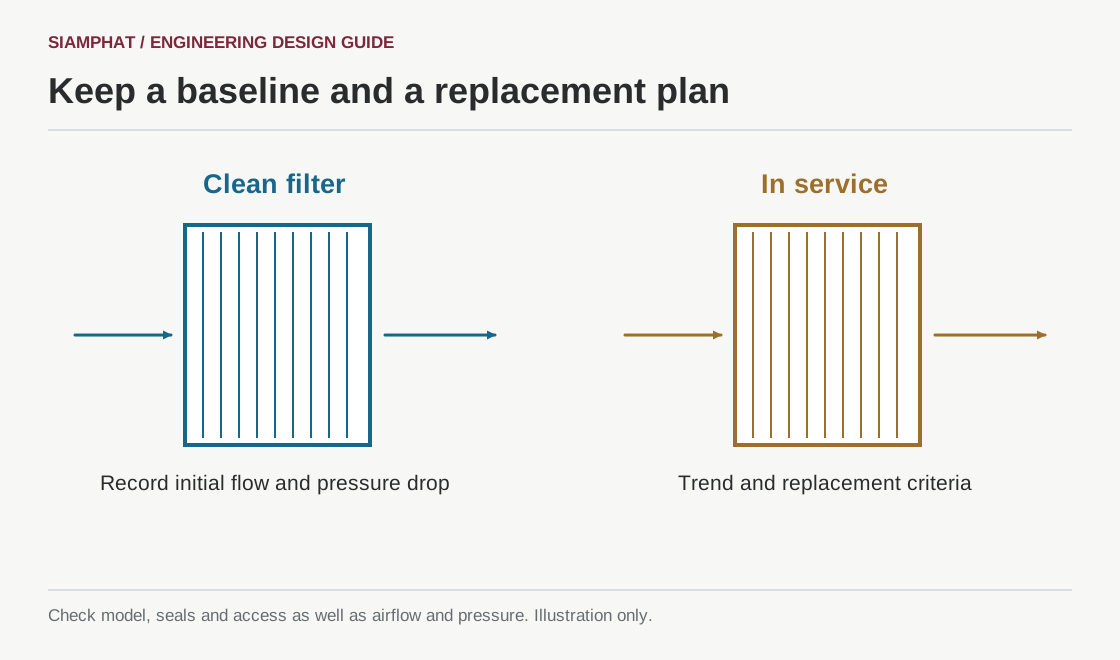
- Record initial airflow and pressure drop with operating conditions.
- Define monitoring and replacement criteria from manufacturer data and use.
- If room improvement is to be evaluated, specify measurements that account for sources and outdoor conditions.
A room particle sensor does not test every part of a HEPA installation. Integrity or special-purpose acceptance testing needs an appropriate method and scope.
Siamphat selects filtration with the supporting air system
We consider contaminants, media, housings, fans, air paths and maintainability together. Required tests and acceptance objectives are defined for each project.
Useful inputs include the problem, cabinet photographs, filter space, fan model, known airflow and replacement constraints. If the target substance is unknown, assessment should precede technology selection.
Questions about air filtration
Is HEPA best for every job?
Select around the need and supporting system. Appropriate fine filtration may meet a duty while retaining required flow and maintainability.
Does particle filtration remove CO₂?
No. Outdoor-air exchange needs separate consideration for occupant-generated CO₂.
How many months between changes?
It depends on the model, dust loading, hours, conditions and specified replacement criteria. There is no one interval for every building.
Does carbon remove every odour?
No. Media have substance-specific behaviour and finite capacity; address the source when possible.
References and scope
- U.S. EPA — Residential Air Cleaners: A Technical Summary, 3rd edition (2018) ↗
- U.S. EPA — What is a MERV rating? ↗
- U.S. EPA — Air Cleaners and Air Filters in the Home ↗
Sources support principles; they are not product certificates or a claim of project compliance. Actual design requires the applicable editions, requirements, model data and installation conditions. Residential or general sensor guidance does not substitute for special-purpose building criteria.
Connect the complete system
DISCUSS YOUR PROJECT
Which filtration approach fits your building?
Tell us about the contaminant and existing air system so we can discuss filtration alongside system resistance.
Start with a plan, site photographs, existing equipment and the times when the problem occurs.