
04 / ERV / HRV
Energy-recovery ventilation
Bring outdoor air in while managing the conditioning load.
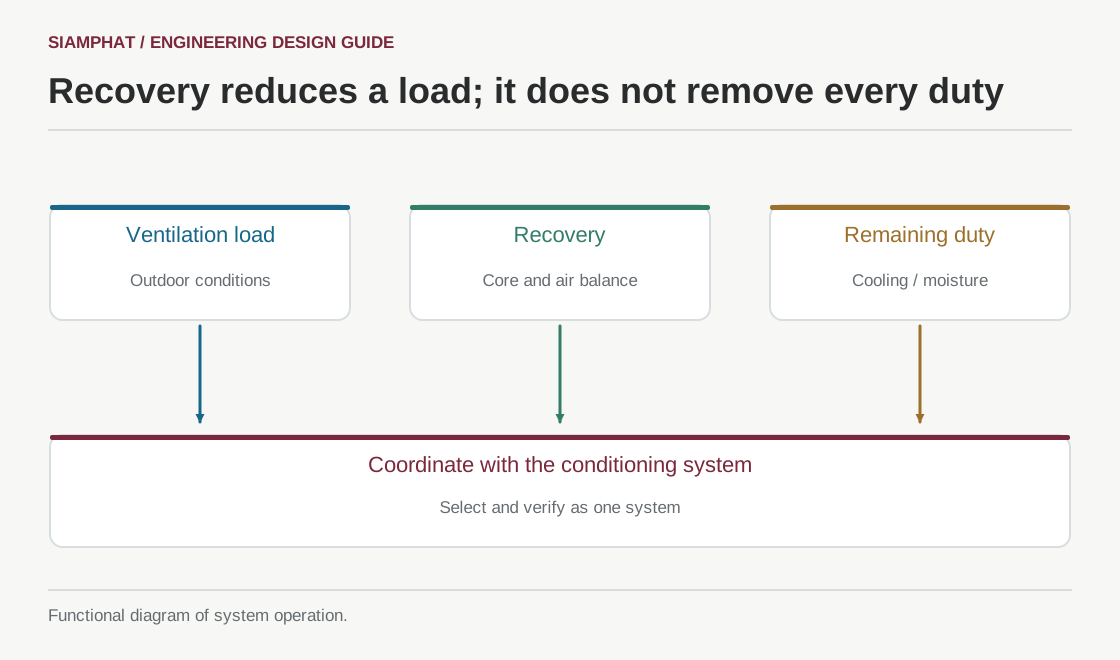
Enclosed, conditioned buildings still need outdoor air. That air can add heat and moisture loads. Recovery equipment uses the difference between outgoing and incoming air conditions to reduce part of the required conditioning.
An ERV or HRV is ventilation equipment, not a substitute for air conditioning or dedicated dehumidification in every operating condition.[1]
Content reviewed 6 October 2026
Discuss the application →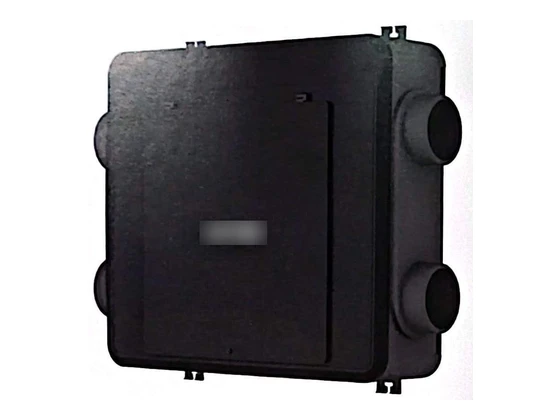
Preserve ventilation while addressing its load
Reducing outdoor air to make a room cool faster can compromise ventilation. Assess the required air duty, the load it brings and options for managing that load.
Outgoing air also needs selection. Exhaust with hazardous substances, grease or strong contaminants cannot automatically be used like general room exhaust. Evaluate the equipment and applicable source requirements.
Understand HRV and ERV
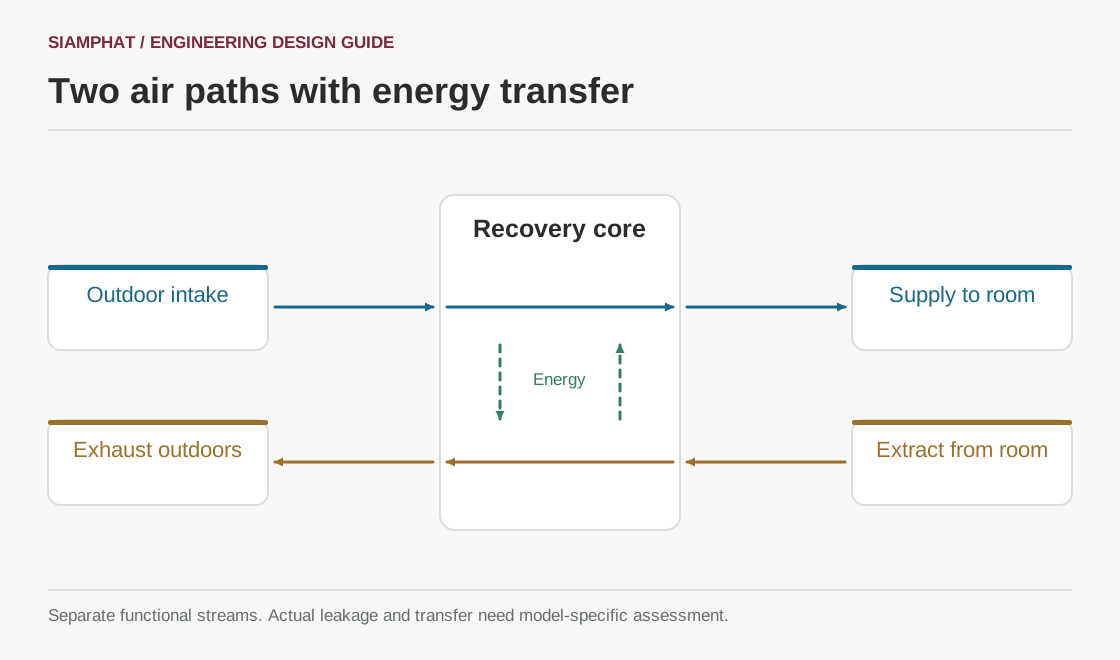
An HRV primarily transfers sensible heat; an ERV can transfer heat and water vapour, depending on the core and conditions. Air paths are separate, but leakage and contaminant-transfer risks need equipment data.[1][2]
In hot, humid conditions, recovery may reduce part of the incoming load; downstream cooling or dehumidification may still be necessary. When outdoor conditions are favourable, bypass or alternative operation may need consideration.
Choose around climate and the complete system
| Approach | Duty | Consideration |
|---|---|---|
| HRV | Sensible transfer | Moisture loads still need assessment |
| ERV | Heat and moisture transfer according to core | Latent performance, leakage and conditions |
| Outdoor-air treatment with coil | Condition incoming ventilation air | Coil capacity, drainage and coordinated control |
| Supply/exhaust without recovery | Provide the required air exchange | Compare total energy and installation constraints |
Use the same airflow and test conditions for comparisons. Temperature alone does not establish moisture performance or total input power.
Read the full performance basis
- Supply and exhaust flow and available external pressure.
- Sensible, latent or enthalpy effectiveness with definitions and conditions.
- Core pressure drop, fan input, leakage and contaminant-transfer provisions.[2]
- Intake/exhaust location, filter/core access, condensate and controls.
Balance and moisture still need design
Two fans do not prove balanced installed flow. Different ducts or filter loading can change the air balance and building pressure. Measure both streams and coordinate them around the pressure objective.
Check latent load with the coil and controls rather than assuming recovery eliminates it. Define responses when weather changes or the main conditioning system stops.
Application: a classroom needing continuous outdoor air
Measure both sides
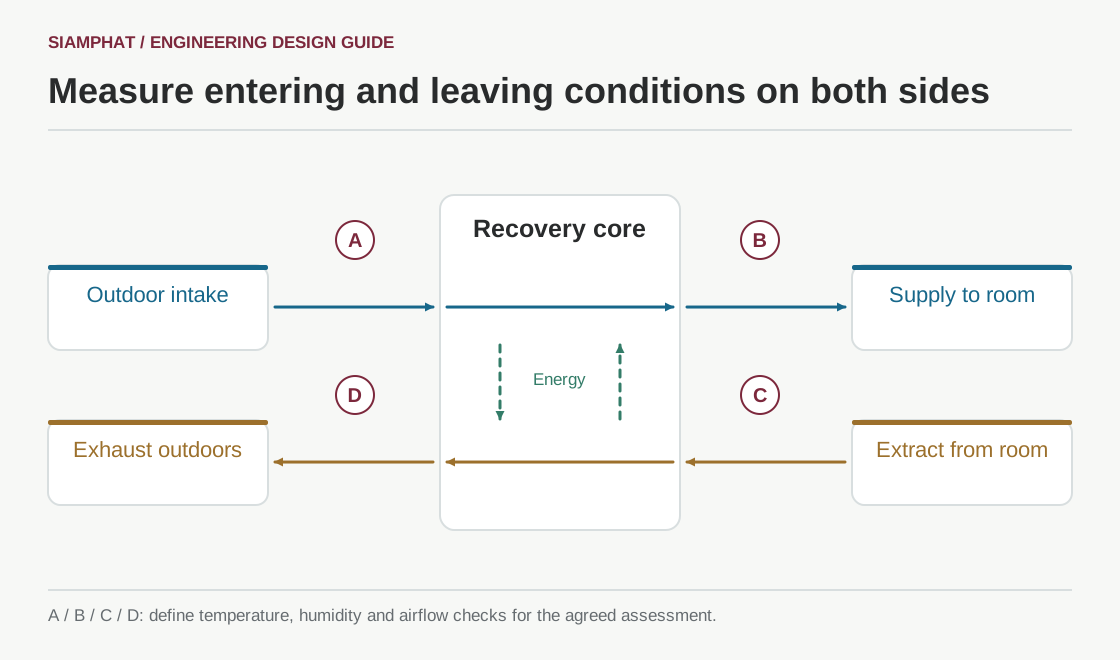
- Verify supply and exhaust volumes with filter and damper states recorded.
- Measure entering/leaving temperature and humidity where performance evaluation is required.
- Test bypass, alarms and coordination with cooling.
- Check intake/exhaust separation, sealing and core-cleaning access.
One day of measurements does not represent annual energy. Separate functional acceptance from annual estimates and document the estimate assumptions.
Siamphat coordinates ventilation and conditioning
We start with air duties and site constraints, then coordinate the core, fans, filtration, ducts and moisture treatment. Energy statements require a defined comparison and supporting information.
Occupancy, hours, existing cooling, duct space and pressure/moisture objectives help establish the options.
Questions about ERV and HRV
Does an ERV cool like air conditioning?
It manages part of the ventilation load through transfer, but does not replace the remaining cooling and moisture duty.
Is an HRV impossible in humid weather?
Assess its sensible function and moisture treatment in the complete system. Do not decide from the name alone.
Must supply always equal exhaust?
The target depends on building pressure and other exhaust, but both actual flows and their effects must be known.
Can any exhaust feed recovery?
No. Contaminants, core suitability, leakage and applicable requirements need assessment.
References and scope
- U.S. DOE — HVAC Energy Recovery Ventilation ↗
- ASHRAE Handbook — Air-to-Air Energy Recovery Equipment (2024) ↗
- ASHRAE Handbook — Ventilation and Infiltration (2025) ↗
Sources support principles; they are not product certificates or a claim of project compliance. Actual design requires the applicable editions, requirements, model data and installation conditions. Residential or general sensor guidance does not substitute for special-purpose building criteria.
Connect the complete system
DISCUSS YOUR PROJECT
Considering outdoor air and cooling load together?
Discuss airflow and operating conditions with us to assess an appropriate ERV or HRV solution.
Start with a plan, site photographs, existing equipment and the times when the problem occurs.