
02 / Positive-pressure ventilation
Filtered outdoor air & positive pressure
Keep outdoor dust out without leaving ventilation behind.
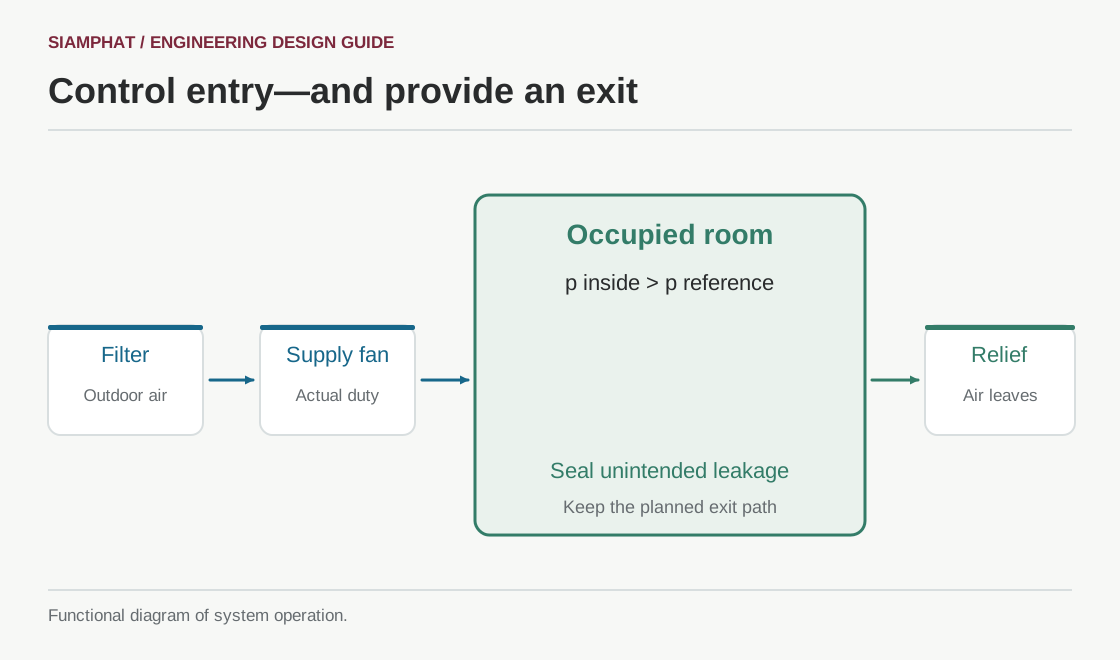
Sealing windows and leakage paths helps control dust ingress, but occupants still need ventilation. A filtered supply and positive-pressure approach therefore needs an outdoor-air source, suitable filters, a fan, an air barrier and a planned way for air to leave.
The objective is controlled, filtered air entry and reduced uncontrolled inflow from less-clean areas—not the highest possible room pressure.[1]
Content reviewed 6 October 2026
Discuss the application →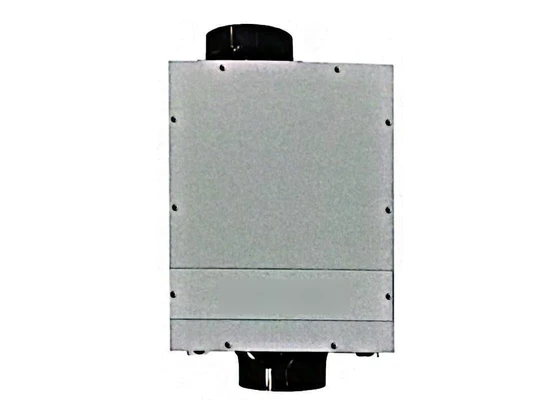
Find the dust path and the pressure reference
Dust can enter through doors, gaps or replacement air drawn in by exhaust fans. Recirculating cleaners can remove particles without providing outdoor-air exchange or preventing that inflow.
Identify whether sources are outside or inside, which exhaust systems operate, and the area against which room pressure is measured. Wind can change exterior pressures; positive pressure relative to a corridor does not prove outward flow at every exterior opening.
Seal, pressurise and filter together
- Seal: reduce unintended leakage while retaining designed relief paths.
- Pressurise: coordinate supply, exhaust and opening flows around a defined pressure objective.
- Filter: select media and a fan that delivers the required flow at installed resistance.
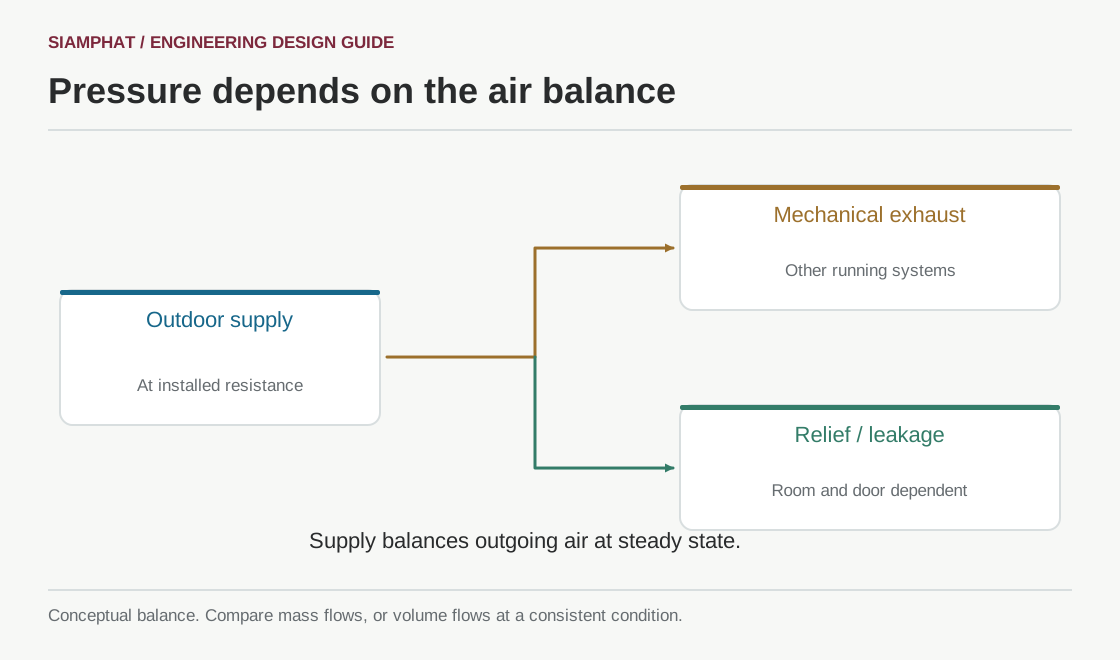
At steady state, incoming and outgoing air mass balance. Supply beyond mechanical exhaust leaves through relief paths or leakage. The resulting pressure depends on leakage and external conditions; free-air fan volume is not a room-pressure specification.
Separate the duties of the available approaches
| Approach | Main duty | Limitation |
|---|---|---|
| Recirculating purifier | Reduce particles in the air passing through it | Does not itself provide outdoor-air supply or positive pressure |
| Filtered outdoor supply | Provide ventilation air with particle control | Requires an exit path and assessment of heat and moisture |
| Coordinated supply and exhaust | Manage ventilation and pressure direction together | Needs leakage, doors and operating sequences considered |
Filtration complements source control and ventilation. A low particle reading does not establish all aspects of air quality.[3]
Select the fan and pressure target from the room
First determine the outdoor-air duty, exhaust demand and leakage behaviour. The fan must overcome the intake, ducts, filters, terminals and relevant room-pressure requirement.
- Define both pressure reference points and a measurement method.
- Consider clean and loaded filters and bypass around the frame.
- Account for doors, toilets, kitchens and other exhaust duties.
- Locate intakes away from relevant contamination and recirculating exhaust.[2]
A tighter room changes the operating point
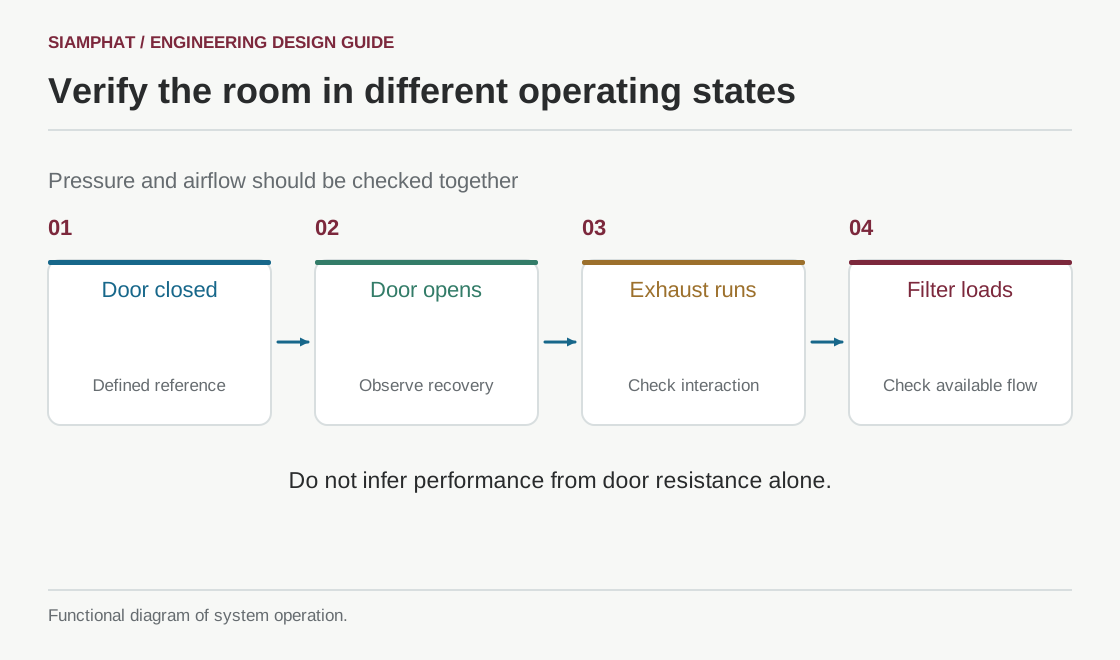
Reducing leakage can raise pressure while reducing fan flow. Loading filters can reduce supply again. Check both flow and pressure; a harder-to-open door is not a complete performance test.
Outdoor air may add heat and moisture. Air treatment or coordination with cooling can be necessary. Rooms with internal pollutant sources need specific airflow and source-control assessment rather than automatic pressurisation.
Application: an office exposed to road dust
Verify operation under relevant conditions
- Measure outdoor supply and differential pressure with defined system states.
- Test doors and interacting exhaust systems.
- Check filter installation, sealing and initial pressure drop.
- Record particle and room observations with outdoor conditions, occupancy and activities.
Maintain filters, seals and dampers and review balance when use changes. Internally generated dust may require separate source control.
Siamphat assesses the unit and the space together
We coordinate sealing, supply, filtration, exhaust and moisture implications around the dust-control objective. Measurements and improvement scope are established for each project.
Room plans, occupancy, exhaust equipment, openings and the observed problem help define a useful starting assessment.
Questions about positive pressure
Should the room have no air outlet?
No. Control unintended leakage and retain an appropriate relief or exhaust route.
Is a larger fan always better?
No. Check the actual duty point, sound, cooling load and room pressure.
Can a polluted room simply be pressurised?
Assess source control and airflow first. Outward flow may move contaminants into neighbouring spaces. Special-purpose areas need their own criteria.
Can one unit serve several rooms?
Possibly, if distribution and transfer paths maintain the required balance, including with individual doors closed.
References and scope
- ASHRAE Handbook — Ventilation and Infiltration (2025) ↗
- ASHRAE Handbook — Airflow Around Buildings (2025) ↗
- U.S. EPA — Air Cleaners and Air Filters in the Home ↗
Sources support principles; they are not product certificates or a claim of project compliance. Actual design requires the applicable editions, requirements, model data and installation conditions. Residential or general sensor guidance does not substitute for special-purpose building criteria.
Connect the complete system
DISCUSS YOUR PROJECT
Dust still entering a closed room?
Discuss sealing, filtered supply and air balance with us to identify an appropriate dust-control approach.
Start with a plan, site photographs, existing equipment and the times when the problem occurs.