
08 / Sensing & controls
Air-quality sensing & controls
Turn trustworthy readings into useful, verifiable control.
A sensor and a dashboard do not automatically improve an air system. Operators need to know what each reading represents, whether it is reliable, and which equipment should respond when conditions change.
A useful control system connects building requirements, measurements, sequences and verified responses, including a defined fallback when data or communication fails.
Content reviewed 6 October 2026
Discuss the application →
Define the decision before adding a sensor
Does a meeting room need changing air delivery? Is filter resistance increasing? Does exhaust upset room pressure? Each question leads to a different measurement and response.
Not every available variable needs a sensor. Define the decisions and responsible operator so alarms lead to action rather than a crowded dashboard.
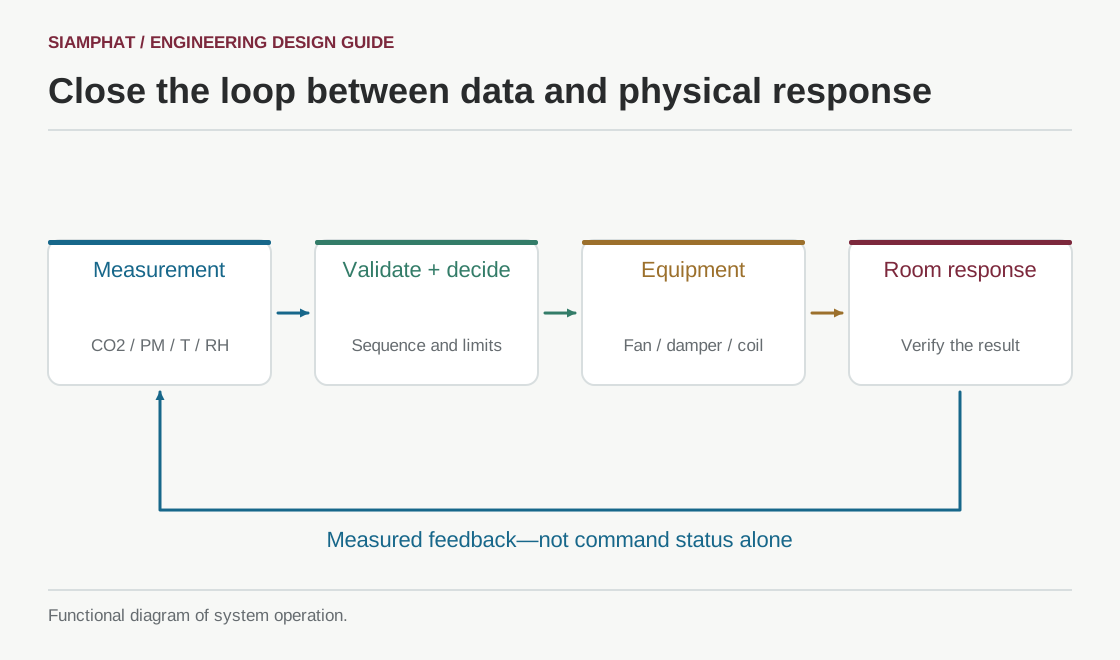
Complete the measurement-to-response loop
Sensors measure conditions; a controller evaluates defined criteria and commands fans, dampers, valves or cooling equipment. Verify that the physical response achieves the intended duty.[1]
An “on” command is not proof of operation. Appropriate feedback may be drive status, airflow or pressure. Distinguish monitoring, alarming and automatic control.
Match each measurement to its purpose
| Variable | Useful indication | Limitation |
|---|---|---|
| CO₂ | Ventilation in an occupant-source context | Not overall IAQ or every pollutant |
| PM2.5 | Particle trends within sensor capability | Aerosol type, conditions and test information matter |
| Temperature/humidity | Room conditions and conditioning coordination | Location and temperature affect interpretation of RH |
| Differential pressure | Room pressure or filter resistance | Define two reference points and system state |
| Flow/equipment status | Confirm delivery or operation | Choose a suitable method and location |
ASHRAE identifies limits to using CO₂ as an IAQ or ventilation indicator. Source assumptions, location and sensor quality matter.[2]
Data must support the intended decision
- Range, accuracy, response and environmental limits from model information.
- Locations representative of the target area rather than a nearby source or discharge.
- Checks/calibration and history; decimal places are not accuracy.
- Units, timestamps, averaging and treatment of missing or implausible values.
EPA sensor guidance supports measurement planning and data interpretation. It does not certify every sensor for indoor control; assess the model and duty separately.[3]
Write a sequence that can be tested
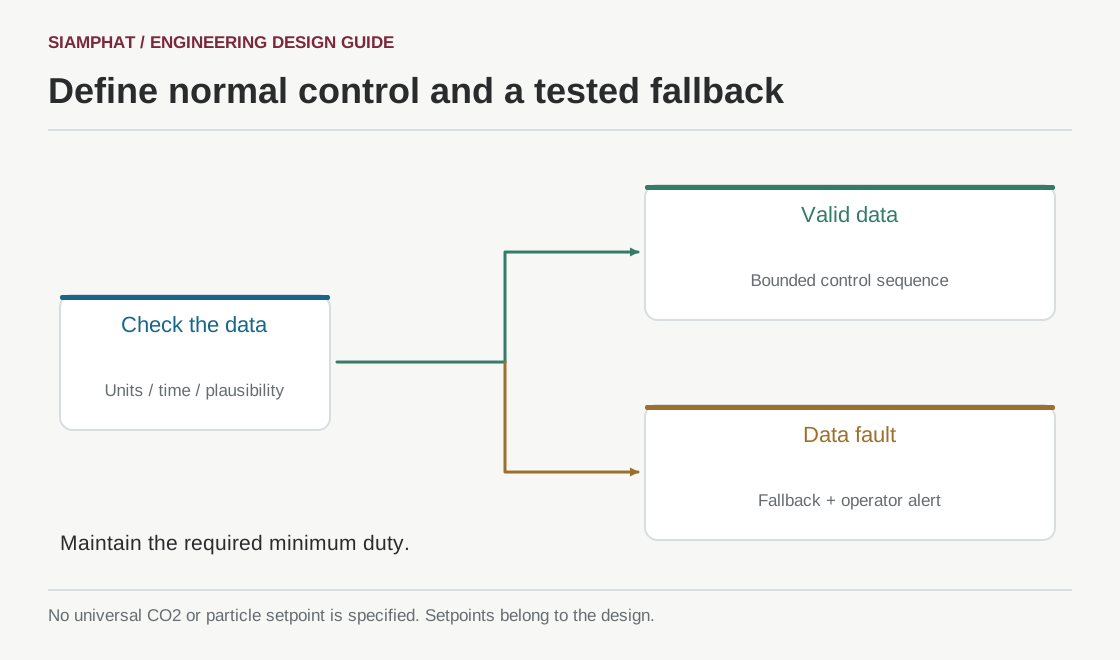
Define setpoints, hysteresis or delays, averaging and equipment limits to avoid unstable switching. Maintain the minimum air duty required by the design even when an occupancy indicator is low.
Resolve priorities when outdoor particles are high but ventilation is needed, or moisture and temperature demands differ. That may require filtration and conditioning coordination rather than closing outdoor air completely based on a particle reading.
Application: a meeting room with variable occupancy
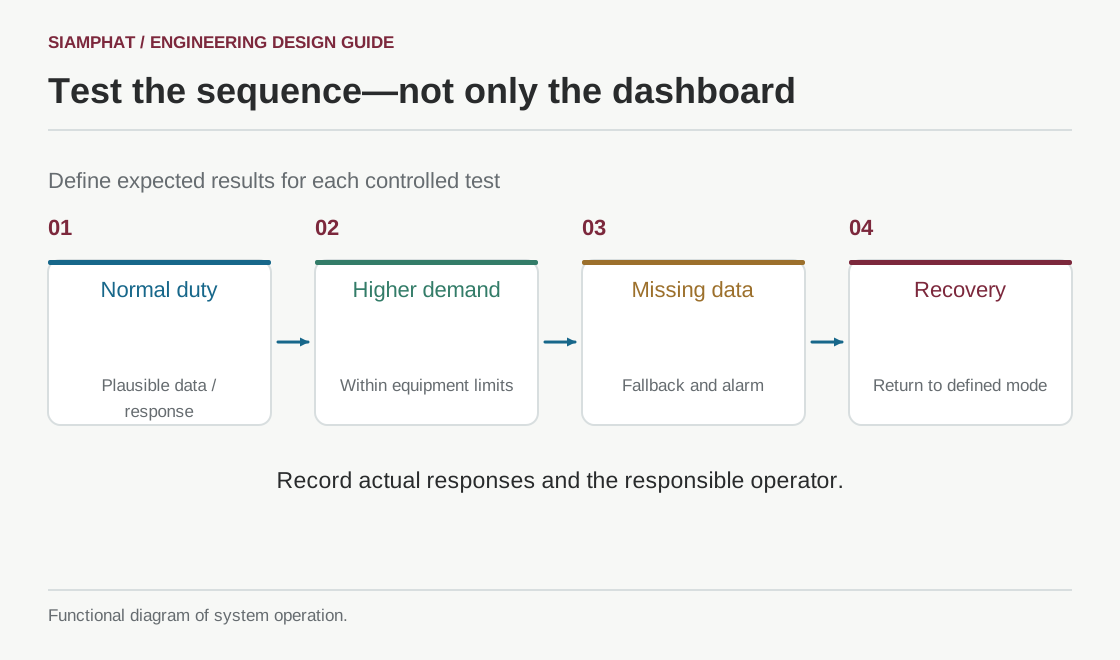
Test commands, responses and failure cases
- Check positions, references, units, timing and plausible measurements.
- Test defined conditions and actual equipment response in a controlled manner.
- Test missing data, sensor faults, communication loss and recovery.
- Verify access to setpoints, records and alarm responsibility.
Maintain sensor checks, backed-up settings and sequences as building use changes. IoT/BMS integration requires compatibility, network and data-scope definition; it is not automatic compatibility with all equipment.
Siamphat connects data to an operating duty
We assess the existing system, suitable points and response sequences together. Monitoring, alarms, integration and testing are scoped for each project.
Plans, existing controls, the questions to be answered and the future operator help shape a useful system.
Questions about sensors and control
Does low CO₂ establish safe air overall?
No. It does not measure every pollutant; assess relevant sources and variables.
Can one sensor represent a whole floor?
Check zoning, distribution and activities. Separately occupied closed rooms may need their own points.
Is AI necessary?
No. A defined conventional sequence may be sufficient. Add tools only where the problem, data and verification justify them.
What should happen when a sensor fails?
Use a specified fallback and alarm appropriate to the system while retaining essential minimum duties. Test it before handover.
References and scope
- ASHRAE Handbook — Design and Application of Controls (2023) ↗
- ASHRAE Position Document on Indoor Carbon Dioxide (2025) ↗
- U.S. EPA — How to Use Air Sensors: Air Sensor Guidebook ↗
Sources support principles; they are not product certificates or a claim of project compliance. Actual design requires the applicable editions, requirements, model data and installation conditions. Residential or general sensor guidance does not substitute for special-purpose building criteria.
Connect the complete system
DISCUSS YOUR PROJECT
Ready to turn readings into useful control?
Discuss measurement points and control sequences with us to connect data with appropriate building operation.
Start with a plan, site photographs, existing equipment and the times when the problem occurs.