
INDOOR AIR QUALITY / IAQ
What is IAQ? Why indoor air quality matters
A good building should offer more than a comfortable temperature. The air people breathe matters to their health and daily experience as much as the features they can see.
Published 5 October 2026
Imagine a clean meeting room with closed doors and comfortable air conditioning. As more people gather, the room begins to feel stuffy, and someone reports a headache.
These symptoms have many possible causes. Indoor air quality is one factor worth investigating: a cool temperature, a tidy interior and the absence of odours do not establish that every aspect of the air is satisfactory.
Indoor Air Quality, or IAQ, should therefore be considered from the start of building design and throughout operation.

What does IAQ mean?
EPA describes IAQ as the quality of air within and around buildings, particularly in relation to occupants’ health and comfort. EPA introduction
Assessing IAQ involves pollutants, their sources, ventilation, moisture and how spaces are used. Two rooms at the same temperature can have very different pollutant concentrations and outdoor-air provision.
Temperature tells us about warmth and cooling; it does not provide a complete assessment of air quality.
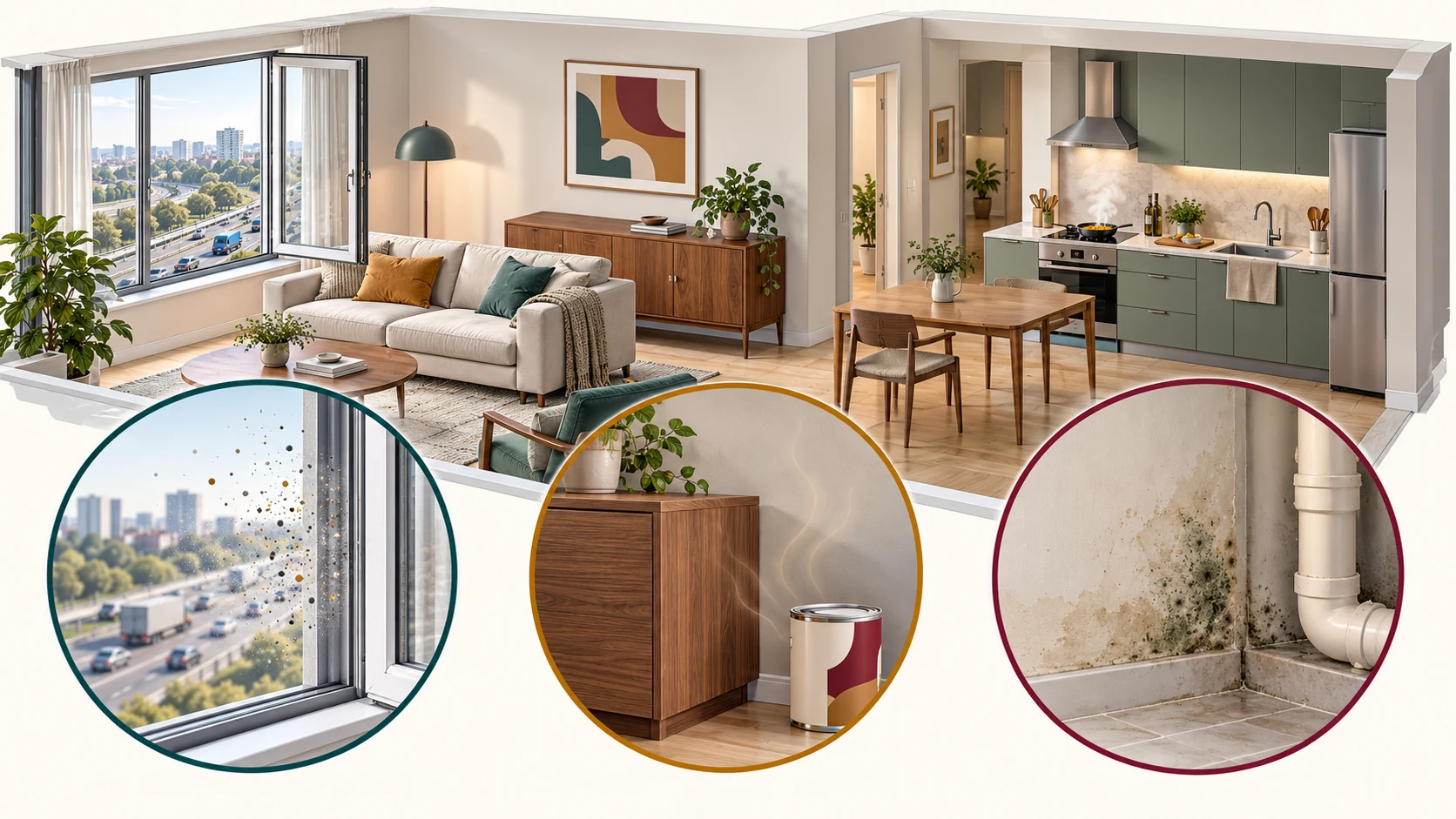
Indoor air contains more than dust
Particles can enter from outdoors or arise from cooking and indoor activities. Settled dust and allergens may be resuspended during use.
Gases and chemicals can originate from paints, adhesives, new furniture, cleaning products and combustion. Volatile organic compounds (VOCs) are a diverse group: their properties and health effects differ.
Biological contaminants can include mould spores, allergens and aerosols that may carry pathogens.
Closing windows may reduce some outdoor pollution, but it does not remove indoor sources. EPA: indoor pollutants and sources
Why does air quality matter?
Exposure to certain pollutants can cause irritation of the eyes, nose and throat, headaches, dizziness or fatigue. Longer-term effects depend on the substance, concentration, exposure duration and individual susceptibility. EPA health information
Symptoms alone do not establish an IAQ problem. Recurring complaints in the same space, particularly among several occupants, warrant a systematic investigation of possible causes.
For building owners, persistent odours, dampness and occupant complaints can indicate issues involving sources, system operation or maintenance.
What can CO₂ tell us?
People exhale carbon dioxide. In occupied rooms, concentrations can rise when outdoor-air ventilation is insufficient relative to occupancy and activity. Measurements can help assess occupant-related ventilation, provided outdoor conditions, timing, sensor placement and other assumptions are considered.
CO₂ is not a comprehensive measure of IAQ. Low CO₂ does not rule out high particle concentrations, chemical pollution or mould. ASHRAE also notes that evidence of direct health and performance effects at concentrations commonly found indoors remains inconsistent. ASHRAE position document
A green reading on one sensor is therefore not evidence that all aspects of the room’s air are satisfactory. Read more: Indoor CO₂ accumulation.
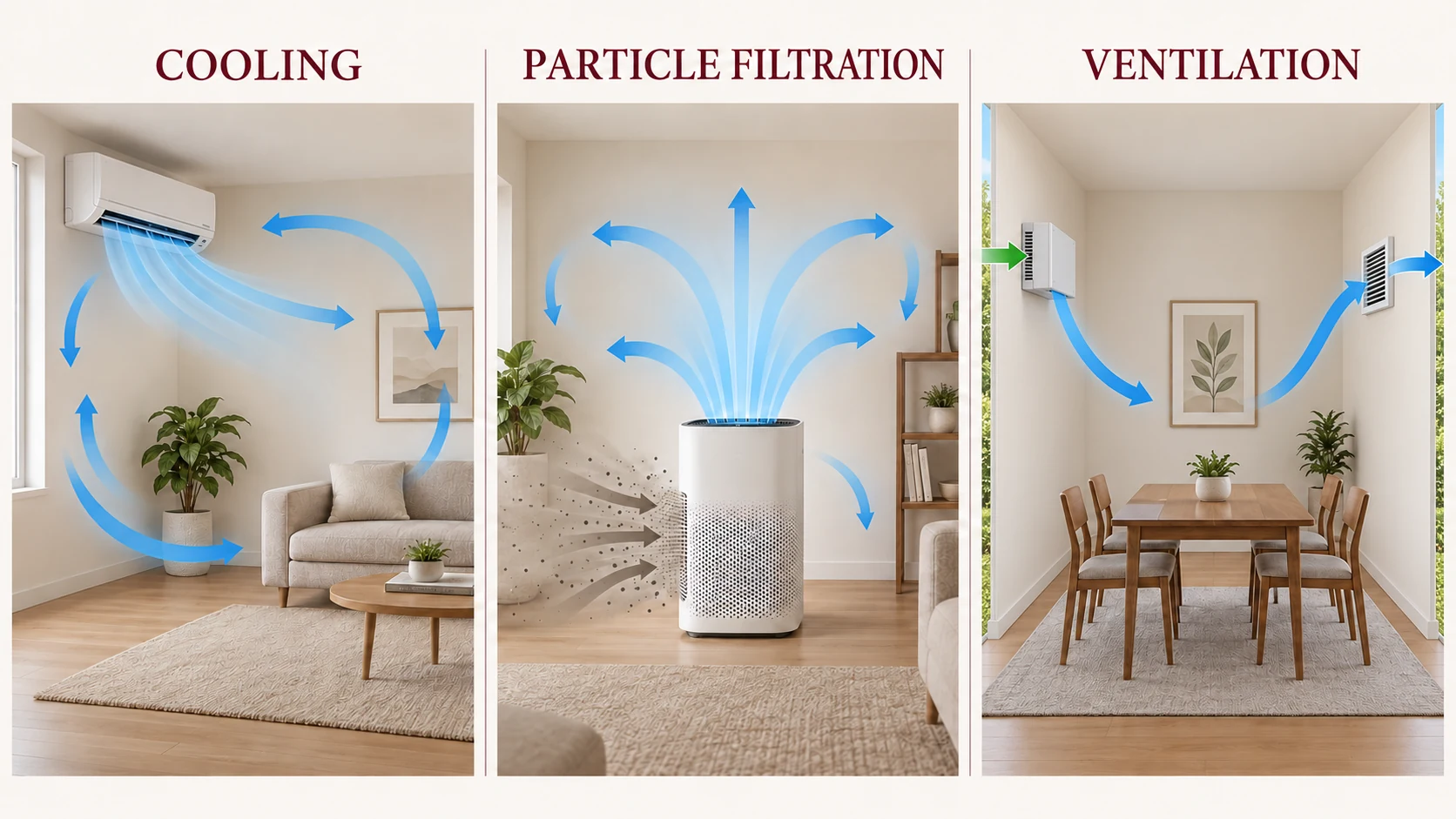
Cooling, filtration and ventilation serve different purposes
A typical split air conditioner primarily recirculates indoor air while cooling it and removing moisture during cooling operation. Without a separate outdoor-air supply, running the unit does not establish adequate ventilation.
A particle air cleaner reduces particles in the air passing through it. HEPA filters do not remove CO₂. Treating particular gases requires appropriate media or processes.
Ventilation supplies air and removes indoor air. Intake quality, distribution and discharge routes must be considered together.
EPA emphasises source control and ventilation with clean outdoor air, with filtration as a supplement. Air cleaners cannot remove every pollutant. EPA: air cleaners and filters
Moisture problems need more than filtration
Leaks, condensation and persistently wet materials can support mould growth even when an air cleaner is running.
WHO identifies associations between dampness and mould in buildings and respiratory symptoms, allergies and asthma. Preventing or correcting persistent dampness is essential. WHO: dampness and mould
Investigate leaks, insulation, condensate drainage and cold surfaces. Filter replacement or surface treatment cannot resolve an underlying moisture source.
Manage IAQ as a system
Start by asking what is being generated in the building, and how it reaches occupants. Coordinate the following measures:
- Control sources: manage smoke and chemicals, select suitable materials and repair leaks.
- Provide appropriate ventilation: account for occupancy, activities and outdoor air quality.
- Choose suitable filtration: consider target pollutants, actual airflow and filter resistance.
- Manage moisture and airflow direction: limit accumulation and contaminant transfer.
- Measure and maintain: verify that systems continue to operate as intended.
A busy meeting room and a room beside a polluted road require different combinations of measures.
Sealing a room and supplying filtered air can support positive-pressure dust control. Adequate air exit paths and control of indoor sources are still necessary. An airtight room alone is not a complete IAQ solution.

Use standards appropriate to the space
ASHRAE Standard 62.1 addresses ventilation and IAQ measures within its scope, while Standard 62.2 focuses on residential dwelling units. Some laboratories and patient-care spaces require additional, specific provisions. ASHRAE standard scopes
A single airflow value or sensor threshold cannot answer every building’s needs. Design must consider space type, occupants, sources, climate and applicable requirements, followed by performance verification.
Where should owners begin?
Record where problems occur, when they arise and which activities coincide with them. Check whether occupancy has changed, outdoor air is actually supplied, filters are maintained, and dampness or unusual odours are present.
This information helps target investigation and corrective measures before purchasing more equipment.
Good air depends on coordinated design, operation and maintenance. Understanding sources and airflow makes it possible to select appropriate measures, verify their effects and sustain building performance.
Related reading: Fresh air, filtration and ventilation and Centrifugal and axial fans.
Every space has its own requirements. Let’s start by understanding yours.
Discuss your project