
AIR DISTRIBUTION / THERMAL STRATIFICATION
Thermal Stratification in High-Ceiling Buildings
Published 5 October 2026
Warm upper layers can be a problem or an intentional design feature. Decide whether to preserve or reduce stratification by evaluating occupied-zone comfort, ventilation and the system energy balance.
An occupied level and the roof space of a tall hall can have different temperatures. One sensor may not represent either the full space or the users, while additional mixing fans can solve one issue and introduce another.
Stratification describes layering. Thermal stratification refers to temperature layering; destratification reduces it through mixing. Neither term is interchangeable with outdoor-air ventilation.
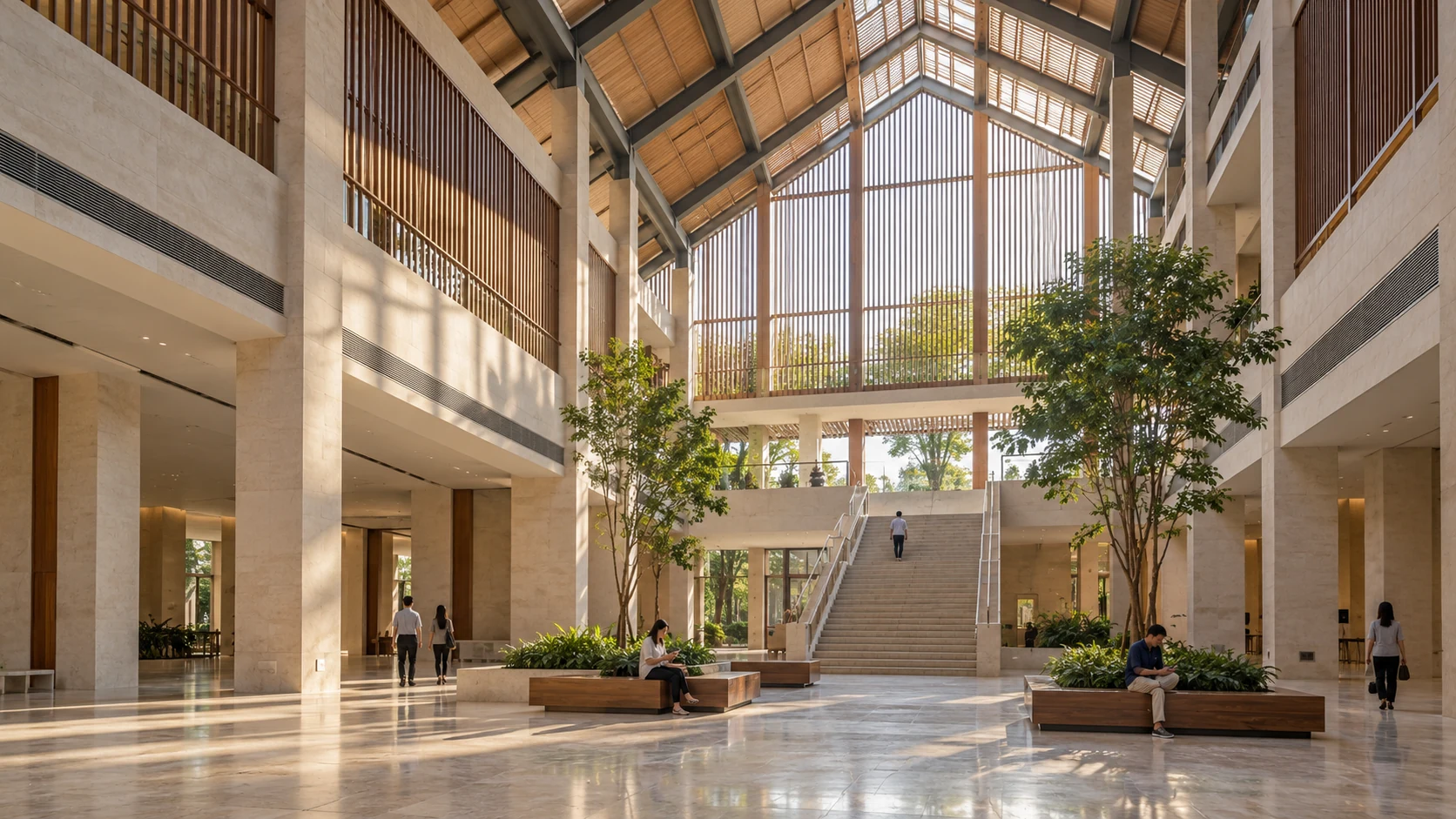
Why does air stratify?
Heating generally lowers air density at comparable pressure, producing buoyancy relative to surrounding air. People, equipment and warm surfaces generate thermal plumes; buoyancy, supplied momentum and air exchange together determine the flow. Linden: natural-ventilation fluid mechanics
“Warm air rises” is a starting explanation, not a complete model. Supply jets, fans, doors and cold surfaces can alter or overturn local flow. Layers need not be stationary or sharply defined. Assess the temperature profile T(z) and its time dependence.
Distinguish layering, stack effect and mixing
Stratification describes the vertical distribution of conditions. Stack effect refers to pressure differences associated with air-column density differences and can drive flow through openings. A closed room can stratify without continuously exhausting air.
High and low openings do not guarantee the intended airflow, because wind and mechanical systems also influence pressure. Destratification is mixing to reduce temperature differences; circulation fans do not automatically increase outdoor-air delivery.
Intentional stratification: displacement ventilation
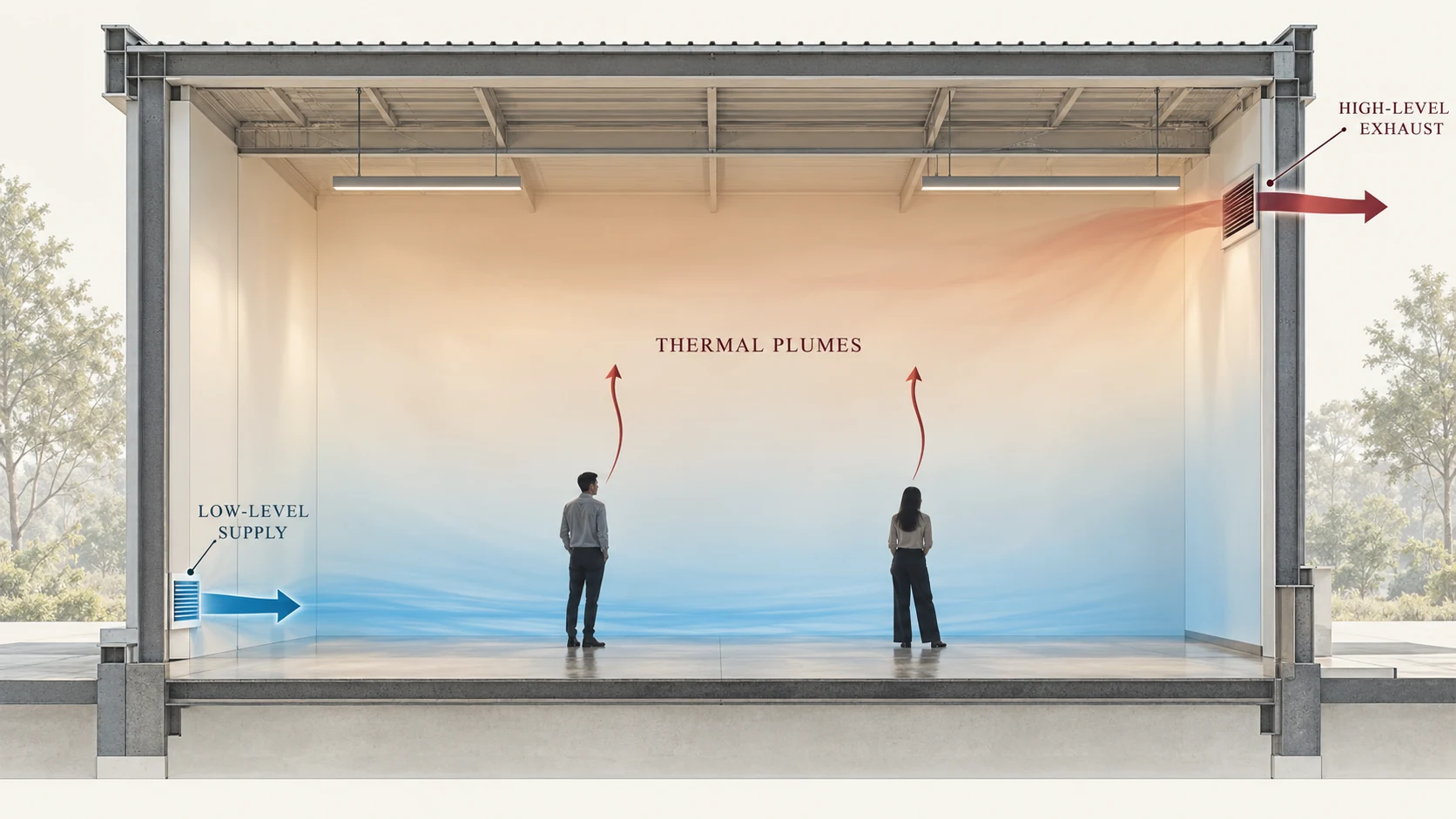
In cooling-mode displacement ventilation, relatively cool air enters at low level and low velocity; thermal sources create upward plumes, with return or exhaust at high level. This differs from a jet-driven fully mixed system. ASHRAE room-air-distribution reference
Design must determine supply flow, occupied-zone conditions, heat-source layout and the level of the transition above the occupied zone. Moving a diffuser to floor level is not sufficient.
Contaminant-removal performance depends on source location, buoyancy, particle or gas behaviour and actual flow. It cannot guarantee removal of every pollutant or pathogen. Occupied-room CO₂ should not be assumed to collect at the floor simply because pure CO₂ is denser than air; mixing and thermal plumes matter.
UFAD does not always mean full displacement
Underfloor air distribution describes the supply arrangement. Many floor diffusers create local mixing and partial stratification. Diffuser momentum and airflow change comfort and the resulting profile. CBE UFAD stratification guidance
Separate outlet position from flow regime. Floor supply is not proof of fully stratified displacement, and a warm upper hall is not proof of good IAQ below.
Buoyancy competes with supply momentum
Non-isothermal jet trajectories are affected by buoyancy. Cold jets can fall and warm jets can rise, so isothermal throw data cannot be used without considering operating temperature differences. ASHRAE space-air-diffusion reference
A useful dimensional scaling is |Ri| ≈ gβ|ΔT|L/U². Here β ≈ 1/T for air with absolute temperature T in kelvin; L and U must be characteristic scales appropriate to the problem. This compares buoyancy with momentum rather than certifying diffuser performance.
For assumed T = 300 K, L = 0.20 m and |ΔT| = 5 K, |Ri| is approximately 0.0082 at 2 m/s and 0.131 at 0.5 m/s: a sixteenfold increase. The example illustrates why part-load operation can change relative buoyancy influence. There is no universal threshold for every geometry.
When should stratification be retained or reduced?
Non-uniform vertical conditions require local comfort assessment, not merely a whole-room average. CBE research on non-uniform environments
Strong mixing can return upper-layer heat to occupants and disrupt the intended flow in stratified cooling systems. In heating applications with warm air trapped aloft, suitable mixing may help redistribute heat.
In tropical buildings, distinguish increased body-level air movement from reduced layering. Comfort improvement from airspeed does not establish lower zone temperature or lower total energy use. Evaluate comfort, ventilation, contaminant transport, plant load and fan power together rather than assuming every tall hall needs HVLS mixing.
Why return-air temperature matters
A simplified sensible balance is qs ≈ ρcpQ(Te − Ts), using actual exhaust or return temperature Te and supply temperature Ts. Return temperature need not equal occupied-zone temperature.
Hypothetical calculation: at 30 kW, ρ = 1.2 kg/m³ and cp = 1.005 kJ/(kg·K), 20°C supply and 30°C exhaust imply about 2.49 m³/s. With the same supply but 25°C mixed return, the balance implies 4.98 m³/s.
This is not evidence of 50% energy savings. Comfort limits, minimum ventilation, moisture loads, cooling efficiency, pressure losses and fan energy remain unevaluated. Storage, surface heat exchange and leakage also limit a steady-state approximation.
A warm upper layer does not stop roof radiation
A hot roof can continue to influence mean radiant temperature below. Insulation and solar control remain relevant even where air is intentionally stratified.
High-level exhaust requires adequate replacement-air paths and a mass balance. Read more: Large-building microclimate design. Comfort ventilation is not a substitute for a separately designed smoke-control system.
Measure the actual vertical profile
Commissioning stratified systems includes evaluating and adjusting room-air profiles; UFAD also requires attention to plenum leakage and supply-air temperature rise. LBNL commissioning research
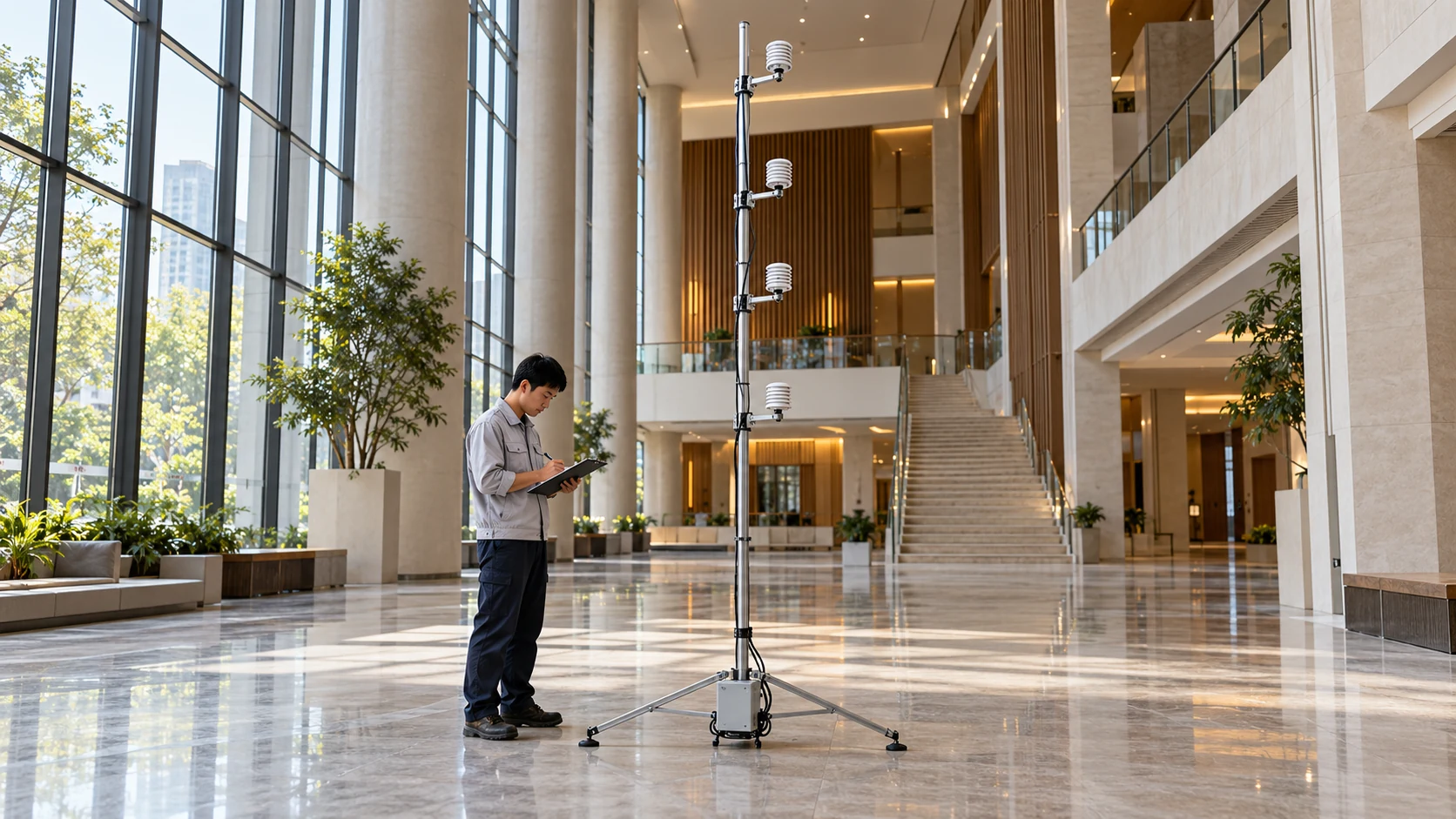
Use sensors at multiple heights and horizontal locations, selected for the building and seated or standing occupants. Include near-floor, ankle and head levels, above the occupied zone and roof level as appropriate.
Control radiant bias and unintended exposure to jets. Log occupancy, heat sources, doors, weather and system operation. Simultaneous measurements avoid confusing temporal changes with vertical differences.
Assess ankle-to-head temperature differences, dT/dz, airspeed, humidity and occupied-zone IAQ. Empty-room measurements do not represent full occupancy. Compare mixing-on and mixing-off conditions under matched operating conditions.
Apply the appropriate criteria
ASHRAE Standard 55 addresses thermal conditions for occupants; Standard 62.1 addresses ventilation and IAQ within its scope. Meeting one does not establish compliance with the other. ASHRAE standard scopes
Check the edition, occupant conditions and applicable method for vertical-temperature-discomfort criteria rather than applying an old handbook number universally.
Before changing outlets or adding fans, establish the intended flow regime, the conditions occupants actually receive, and the net effect on heat removal, ventilation and energy. Stratification is a design variable to manage, not always a defect to eliminate.
Every space has its own requirements. Let’s start by understanding yours.
Discuss your project