
ENGINEERING / BLDC & EC MOTORS
BLDC Motors: matching the motor to the job
A practical guide to brushless motors, torque, electronic drives and efficient building air management.
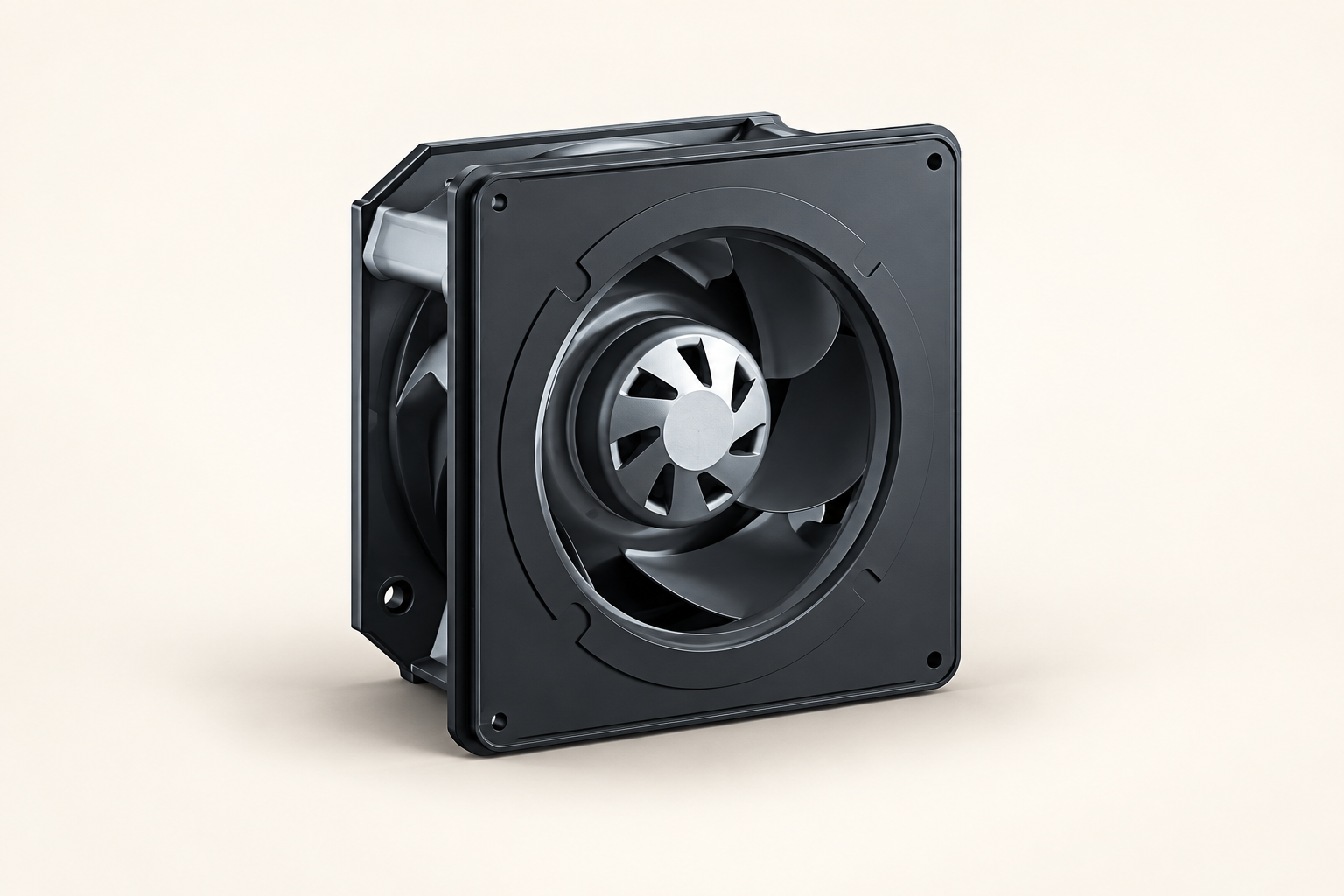
Start with the actual task
Fans, pumps and air-conditioning systems depend on motors. A technology name alone does not determine suitability: power, torque, speed, controls and real operating hours matter.
What makes a motor brushless?
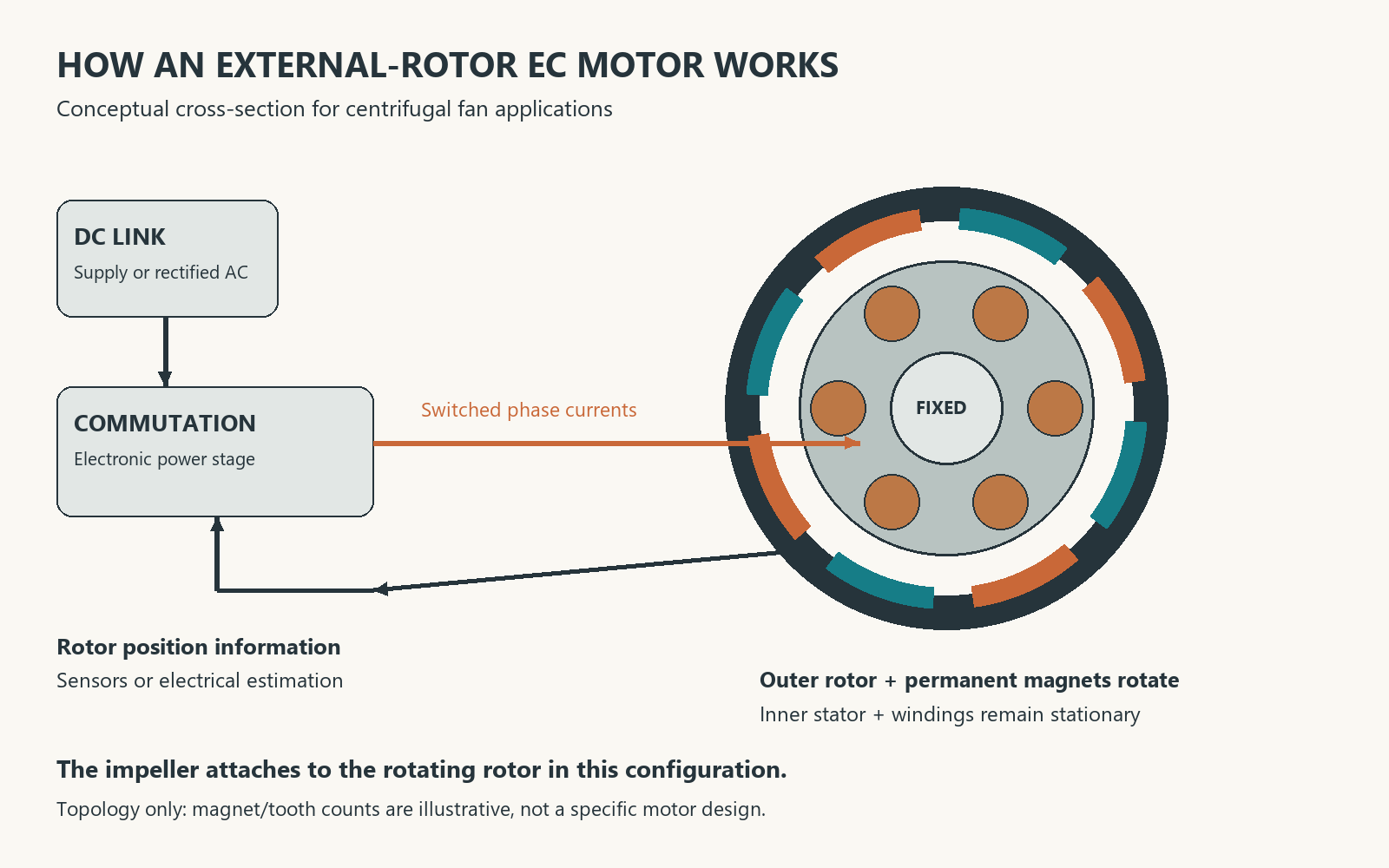
BLDC means Brushless Direct Current Motor. Electronics replace the brushes and commutator of a brushed DC motor. Stationary stator windings interact with permanent magnets on the rotating rotor. Both inner- and outer-rotor layouts exist.
The schematic here shows an external rotor around an inner stationary stator, a real configuration used in EC centrifugal fans. It is not a cutaway of a particular product. The drive switches DC-link energy into phase currents; mains-powered products may rectify AC internally. Bearings and electronics still need maintenance. Texas Instruments motor-drive information
Efficiency comes from motor and control
Permanent-magnet rotors avoid the induced rotor-current losses of induction motors, but winding, iron, mechanical and drive losses remain. Efficiency depends on design and operating point.
Speed control can be equally important. High-efficiency induction motors with suitable VFDs also offer variable-speed operation. Compare equal delivered work using the same electrical measurement boundary.
Why reducing fan speed can save power
Under the assumptions of fan affinity laws, airflow scales with speed, pressure with speed squared and shaft power with speed cubed. At 80% speed, the estimated shaft power is 0.8³ = 0.512 of the original.
This is not a guaranteed 48.8% electricity saving. System characteristics and drive efficiency matter, and minimum ventilation requirements must be maintained. Australian government motor and drive guidance
Choose the technology for the load
Brushed DC, induction and BLDC/EC motors each suit particular tasks. Evaluate operating hours, starting torque, continuous speed, cooling, noise, humidity and serviceability. A properly sized induction motor can be a sound choice for steady loads.
Watts alone do not define torque
Shaft power equals torque times angular speed: Pshaft = Tω. In practical units, T (N·m) ≈ 9550 × Pshaft (kW) / n (rpm). Use mechanical shaft power, not electrical input power.
A 0.1 kW shaft output gives approximately 0.955 N·m at 1,000 rpm or 0.318 N·m at 3,000 rpm. Check the torque-speed curve, starting load and continuous rating rather than relying on a temporary peak rating.
BLDC, PMSM and EC terminology
Textbooks often distinguish trapezoidal-back-EMF BLDC from sinusoidal-back-EMF PMSM, while commercial naming varies. EC describes electronic commutation; building fans often combine a permanent-magnet motor and drive.
Real EC centrifugal fans use forward- or backward-curved impellers. Check actual model data, supply requirements and motor topology. Permanent magnets need not always use rare-earth materials. ebm-papst centrifugal products; external-rotor principles
Control affects noise and starting
Six-step, sinusoidal and field-oriented control differ in implementation. Torque ripple, acoustics and efficiency depend on motor characteristics and tuning. No method is universally best.
Position can be sensed or electrically estimated. Back-EMF-only estimation is limited at standstill and low speed, so loaded starting needs particular attention.
Evaluate the complete fan system
The required output is airflow at a specified pressure. Poor impeller selection or excessive duct resistance can negate a good motor. Compare total electrical input at equal airflow and pressure, including supply and drive losses.
Ask for fan curves, part-load data, speed range, noise and service information. Being BLDC alone does not provide constant airflow: suitable measurement or control is also needed.
Solar compatibility must be designed
A DC-compatible motor-drive system can operate with solar energy, but panel voltage, current and starting requirements must match. A mains-rated EC fan cannot simply be connected directly to a PV panel. Power conditioning may be required to avoid repeated starts in weak sunlight.
Applications in building air management
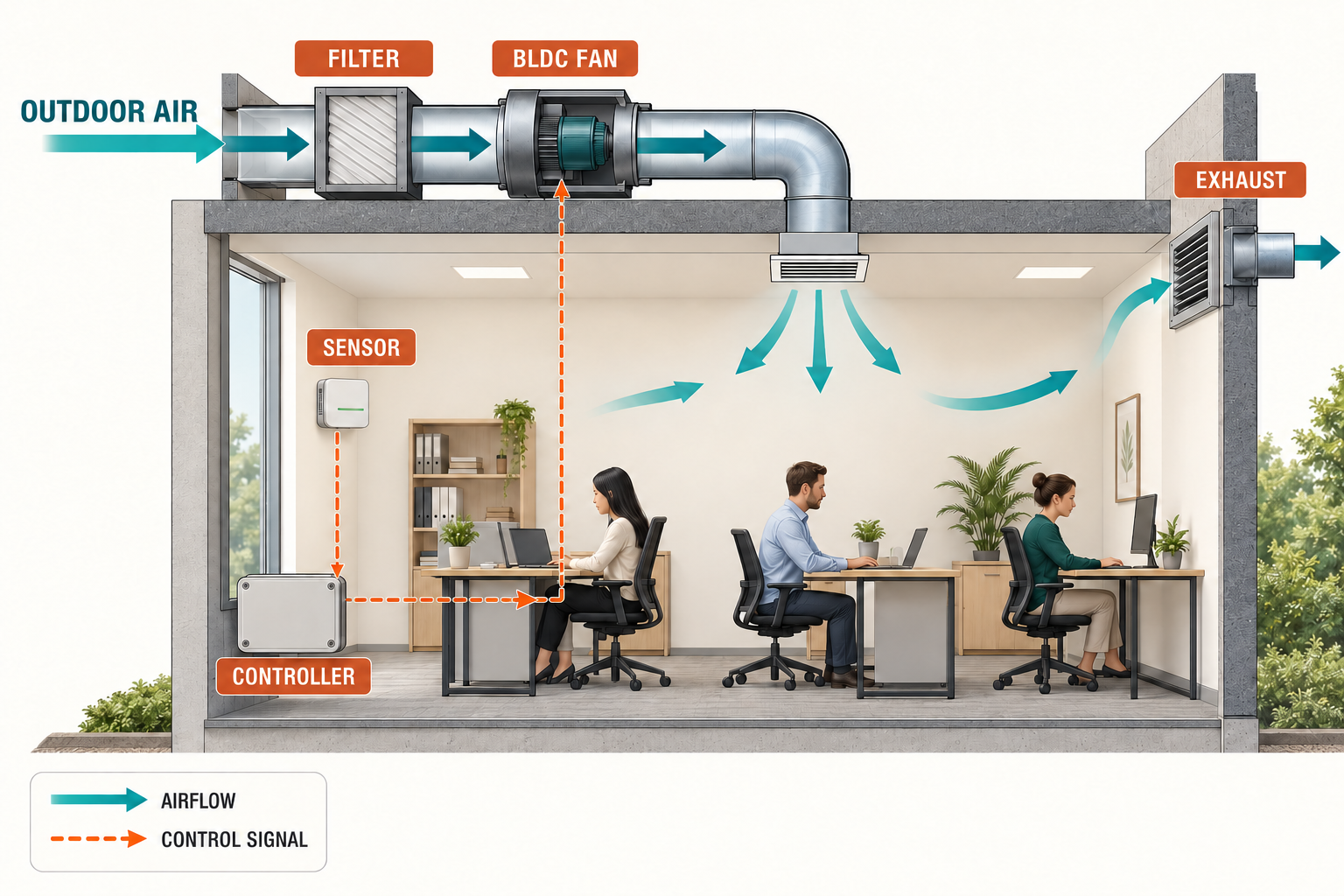
BLDC/EC fans can supply outdoor air, exhaust rooms, circulate air through filters or serve heat-recovery ventilation. Demand can follow occupancy schedules or appropriate sensor information.
CO₂ can inform occupancy-related ventilation but does not represent every contaminant. Maintain required minimum outdoor airflow and account for other sources. The office illustration is a functional concept, not an installation plan.
Filter resistance and pressure control
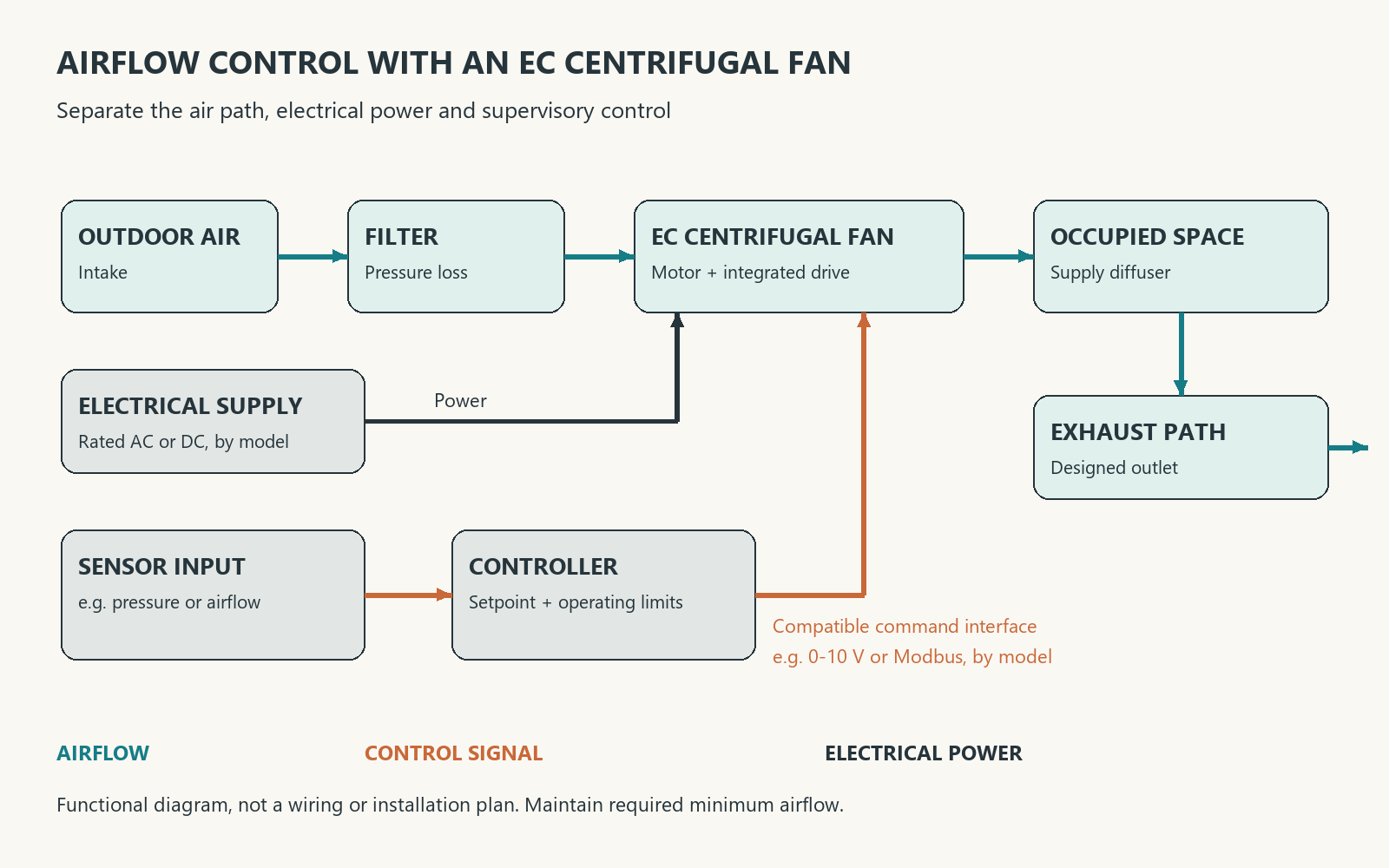
As filters load, resistance increases. A suitable airflow controller can increase speed within fan limits, but power and noise may rise. Monitor filter pressure drop and replace filters rather than compensating indefinitely.
Positive-pressure rooms need balanced supply and exhaust, pressure measurement and attention to leaks and doors. Supervisory control sets demand; the motor drive handles commutation. Compatible 0–10 V or Modbus interfaces are model-dependent. ZIEHL-ABEGG control examples
Benefits of a coordinated system
Potential benefits include lower part-load energy, finer environmental control, reduced noise at suitable speeds, elimination of brush maintenance and monitoring where supported. Bearings, filters and electronics still require care.
Solar attic ventilation must provide adequate outdoor inlets and prevent conditioned room air leaking into the attic. Assess whole-building effects, not motor electricity alone.
The right air, in the right place, at the right time
Siamphat starts with the real load, selects suitable fans and airflow paths, controls operation to demand and verifies results. The aim is appropriate airflow with reliable long-term performance and efficient energy use.
Every space has its own requirements. Let’s start by understanding yours.
Discuss your project